Showing posts with label Ancient. Show all posts

Friday, May 27, 2022

The Nag Hammadi Library

THE NAG HAMMADI LIBRARY (Coptic Christian, 3rd-4th centuries CE)

In 1945 an Egyptian farmer found 13 leather-bound papyrus codices (similar to books, not scrolls) buried in a meter-high sealed jar in a cemetery, perhaps during a simple grave robbery. The finder at first feared the jar might contain a "genie," but when he realized there might be gold inside, he smashed it with gusto. He took the documents home and dumped them next to the oven; his mother admits to having used many pages for kindling. What remains are 52 treatises, most of them Gnostic texts (including the Gospel of Thomas). They were translated into Coptic, a late form of Egyptian, from earlier Greek manuscripts. The collection is named for the Upper (southern) Egyptian town near which it was found; it is currently housed in the Coptic Museum in Cairo, Egypt.


Navigation:

Thursday, May 26, 2022

Hilary of Poitiers

HILARY OF POITIERS (Roman Christian, c. 310-367)

Saint Hilary of Poitiers (actually Hilarius, a man's name meaning "happy") was a Bishop and a Doctor of the Church, sometimes called the "Hammer of the Arians" (and the "Athanasius of the West") for his staunch opposition to Arianism. After a solid pagan education, he was a married man and a father when he read the Bible and converted; his wife and daughter (Saint Abra) were baptized with him. The Christians of Poitiers unanimously elected him bishop in 350 or 353. Like Athanasius, he was exiled by an emperor (but only once, for four years), where he continued writing. The reason for his exile is unclear, but his hobby was getting other bishops condemned for heresy, so it may have been plain old enmity. He left numerous works of theology, history, and hymnody and is remembered in biographies, the names of churches, and as the patron saint of lawyers.


Navigation:

Monday, May 23, 2022

The Ecclesiastical History

THE ECCLESIASTICAL HISTORY (Roman Christian, c. 320 CE)

The Ecclesiastical (Church) History by Eusebius (260 or 265-339) tells the history of Christianity from the time of Christ to nearly the time of the author, stopping sometime around 320, during the reign of Constantine, the first officially Christian Roman emperor and Eusebius's patron. Arranged chronologically into 10 books, it incorporates and thus preserves long portions of documents no longer available to us. Its value as history has been argued: some consider it accurate, and some think it little more than pro-Constantine propaganda. Nevertheless, it is the first such history of Christianity, and set the style for later works, earning Eusebius the title "Father of Church History." He also wrote Biblical commentaries, a life of Constantine, and other, lesser works of history, including a Chronicle purporting to give the history of each nation--Assyrians, Chaldeans, and so on up to the Romans--from more or less "the beginning" (the Hebrew Chronicle starts with Adam).


Navigation:

Thursday, May 19, 2022

The Avesta

THE AVESTA (Persian Zoroastrian, 224-651 CE)

The Avesta is the main collection of religious texts of Zoroastrianism. It was composed in Avestan; this language was spoken by ancient Iranians, and is close to the Vedic Sanskrit used in the Rig Veda. The principal liturgical text is the Yasna, which is the name of Zoroastrianism's primary act of worship, at which the text is recited. The most important part are the five Gathas, consisting of seventeen hymns which are attributed to Zoroaster himself.

Other sections of the Avesta include:

  • The Visperad, supplements to the Yasna; 
  • The Vendidad, a list of evil spirits and how to conquer them;
  • The Yashts, 21 hymns devoted to various deities; 
  • The Siroza, a list of the 30 divinities that preside over the days of the month;
  • The Nyayeshes, prayers for regular recitation;
  • The Gahs, invocations to the five divinities that watch over the five divisions of the day; and 
  • The Afrinagans, four "blessing" texts for various occasions.


Navigation:

Wednesday, May 18, 2022

The Six Enneads

THE SIX ENNEADS (Plotinus, Greek, c. 270 CE)

The Six Enneads ("groups of nine") are a collection of the writings of the Greek philosopher (born in Roman Alexandria, Egypt) named Plotinus (c. 204/5-270 CE), but compiled by his student Porphyry about the year of his death. With his teacher Ammonius Saccas, Plotinus was a founder of Neoplatonism (a label from the 19th century CE), a philosophical and religious system that extended the thought of Plato in a way that affected later Christian thinking. It focuses on three fundamental principles: the One (which "has its center everywhere but its circumference nowhere"), the Intellect (or nous, sometimes identified with God), and the Soul (an inner response to the nous).


Navigation:

Tuesday, May 17, 2022

Cyprian of Carthage

CYPRIAN OF CARTHAGE (Roman Christian, c. 210-258 CE)

Cyprian (Thaschus Caecilius Cyprianus) was a bishop of Carthage, the once-Phoenician city in North Africa. Of Berber descent, he is considered a saint in both West and East. He was the greatest of Latin Christian writers in the West before the arrival of Jerome and Augustine, his most famous treatise being De Ecclesiae Catholicae Unitate ("On the Unity of the Catholic Church"). After receiving a classical education, he converted to Christianity and soon became a bishop. He was known for his his strong pastoral skills, firmness of faith, and eventual martyrdom by the sword.


Navigation:

Monday, May 16, 2022

The Mahabharata

THE MAHABHARATA (Vyasa?, Indian, before 200 CE)

The Mahabharata (meaning, perhaps, "The Great [Epic of] India") is one of the country's two great epics, the other being the Ramayana. The Mahabharata tells of a dynastic struggle between two groups of cousins, with a gambling game as the MacGuffin that gets the struggle going. The five Pandavas (our heroes) and their wife (it's complicated) lose to their Kaurava cousins (whom some believe cheated) and undergo 12 + 1 years of exile. Many folktales are incorporated into their years of wandering. The struggle at last comes to a head in the great 18-day Kurukshetra War (occupying 1/4 of the book), which the five Pandavas win (all surviving) though the moral complexity of slaughtering kin makes the victory somewhat hollow, a point we'll discuss when we reach the Bhagavad Gita, which is imbedded in this much larger work.


Navigation:

Thursday, May 12, 2022

The Mahapuranas

THE MAHAPURANAS (Indian, unknown dates, perhaps from c. 250 CE)

The Puranas (a Sanskrit word meaning "ancient") constitute a vast genre of Indian literature on a wide range of topics, mostly related to the gods and their activities, including the Mahabharata; holy places and festivals; cosmology and the world; genealogies of various dynasties; and the practice of Yoga. Out of the many, 18 have been designated Maha ("great") puranas (though the texts included may vary depending on the source). The shortest purana is 9,000 verses; the longest, 81,100; many individual verses appear in more than one purana. Most of the Mahapuranas are named for Hindu gods. One list has: Brahma, Padma, Vishnu, Shiva, Bhagavata, Narada, Markandeya, Agni, Bhavishya, Brahmavaivarta, Linga, Varaha, Skanda, Vamana, Kurma, Matsya, Garuda, and Brahmanda.


Navigation:

Wednesday, May 11, 2022

Shudraka

SHUDRAKA (Indian, unk. date, perhaps 3rd or 5th century CE)

Three extant Sanskrit plays are attributed to one Shudraka, who may have been a king (perhaps in the Abhira dynasty, which lasted from 203-315 or 370 CE), or could be a mythical figure. But the plays are real:

  • Mrichchhakatika (The Little Clay Cart), a ten-act drama in which a noble but impoverished young Brahmin (priest) falls in love with a wealthy courtesan, but their relationship is threatened by an aggressive rival.
  • Vinavasavadatta, a nine-act play (only eight survive) in which a king tries to "match" his daughter with another king; when the prospective groom refuses, the father imprisons him to break his pride--and it works!
  • Padmaprabhritaka, a bhana--a short one-act monologue in which one actor may take many parts.


Navigation:

Tuesday, May 10, 2022

Lalitavistara Sutra

LALITAVISTARA SUTRA (Mahayana Buddhist, 3rd century CE)

The Lalitavistara Sutra is a 27-chapter Sanskrit Mahayana Buddhist text, and a partial "autobiography" of the historical Buddha from the time he came down from the Tushita heaven (where he resided before being reborn on Earth as Prince Siddhartha Gautama) until his first sermon (after his Enlightenment) in the Deer Park near Varanasi, which launched his public mission. It covers his (re)birth and childhood, education, courtship, palace life, departure and search, asceticism, temptation, and attainment. It is portrayed in a series of reliefs at Borobudur.

  • The name has been translated "The Play in Full," hinting that the Buddha's last incarnation was a performance given for the benefit of the beings in this world.


Navigation:

Monday, May 9, 2022

Lives and Opinions of Eminent Philosophers

LIVES AND OPINIONS OF THE EMINENT PHILOSOPHERS (Diogenes Laërtius, Greek, fl. 3rd century CE)

Diogenes Laërtius is not to be confused with the Athenian Diogenes the Cynic (c. 412-323 BCE). It doesn't matter much, though, as little is known of the later Diogenes--ironic, as his subject is biography. His dates are uncertain, and even his name has taken several forms--this is just the one we have settled on in modern times--and the meaning of Laërtius--whether name, nickname, or place of origin--is unknown. The Lives is a work of uneven value: Diogenes seldom assessed his sources, accepting whatever he was told. On the other hand, his is the only surviving version of some of those sources, making his work invaluable. The Lives as we have it covers around 80 Greek philosophers, starting with the legendary "Seven Sages." Six other philosophers are also mentioned incidentally, and a table of contents shows that Book VII in our incomplete manuscripts once included 20 more.


Navigation:

Sunday, May 8, 2022

Origen of Alexandria

ORIGEN OF ALEXANDRIA (Roman Christian, c. 185-253 CE)

An early Christian theologian, Origen was born in Alexandria and spent the first half of his life there, until conflict with a jealous bishop, Demetrius, caused him to relocate to Caesarea. As a lad he tried to be martyred with his dad (who was beheaded), but Mom hid his clothes to keep him home (willing to die, but not to be embarrassed). He wrote about 2,000 theological treatises. Some consider him a "Church father," one of the greatest geniuses of the early church; but scurrilous charges by Demetrius--including that he castrated himself, and that he believed Satan could be redeemed--lessened his chances of universal acceptance. Being ordained by a friend, the bishop in another jurisdiction, caused Demetrius to accuse him of insubordination. Tortured by the Romans for his faith in 250--but never renouncing it--he died of his injuries a few years later.

  • On the First Principles was the first systematic exposition of Christian theology.
  • Contra Celsum was a point-by-point reply to a scathing attack by the Pagan philosopher Celsus.

Navigation:

Thursday, May 5, 2022

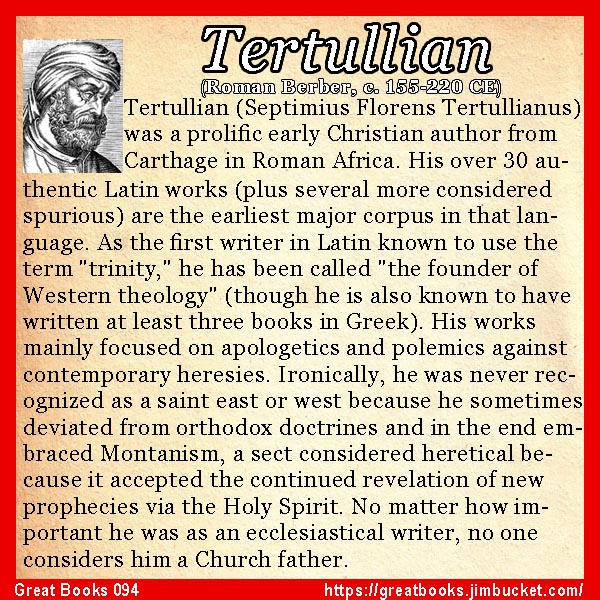
Tertullian

TERTULLIAN (Roman Berber, c. 155-220 CE)

Tertullian (Septimius Florens Tertullianus) was a prolific early Christian author from Carthage in Roman Africa. His over 30 authentic Latin works (plus several more considered spurious) are the earliest major corpus in that language. As the first writer in Latin known to use the term "trinity," he has been called "the founder of Western theology" (though he is also known to have written at least three books in Greek). His works mainly focused on apologetics and polemics against contemporary heresies. Ironically, he was never recognized as a saint east or west because he sometimes deviated from orthodox doctrines and in the end embraced Montanism, a sect considered heretical because it accepted the continued revelation of new prophecies via the Holy Spirit. No matter how important he was as an ecclesiastical writer, no one considers him a Church father.


Navigation:

Wednesday, May 4, 2022

Nagarjuna

NAGARJUNA (Indian Buddhist, c. 150-250 CE)

An Indian Mahayana Buddhist scholar, he is widely considered one of the most important Buddhist philosophers. He is credited as founding the Madhyamaka or "Middle Way" School. To "prove" that all existence is "empty" (that is, devoid of self-existence, or that all things are dependent on all others) he employed what has been called the tetralemma (like a dilemma, but with four choices):

  1. A is A. [affirmation]
  2. A is not A. [negation]
  3. A is both A and not A. [double affirmation]
  4. A is not A nor not not A. [double negation]
    [Therefore, all is empty]

An oversimplified, homely example:

  1. A rose is a rose.
  2. A rose is not a rose (e.g. it is made up of constituent parts).
  3. A rose is both a rose and not a rose (1 & 2).
  4. A rose is not a rose nor not not a rose (2 & 1).
    [Therefore, all is empty]


Navigation:

Tuesday, May 3, 2022

Clement of Alexandria

CLEMENT OF ALEXANDRIA (Roman Christian, c. 150-215 CE)

Clement of Alexandria (Titus Flavius Clemens) was a Christian theologian and philosopher in Roman Alexandria, Egypt (though he may have been born at Athens and died at Jerusalem). Having been educated in classical Greek philosophy and literature, his three major works demonstrate greater influence by these disciplines than those of any other Christian thinker of his time. He may also have been familiar with pre-Christian Jewish esotericism and Gnosticism. Considered a Greek "Church Father," he left three works called a "trilogy":

  • The Protrepticus (The Exhortation), an attempt to evangelize the Greeks that includes a supposed history of Greek religion;
  • The Paedagogus (The Tutor), reflections on Christ's role in teaching humans to act morally and to control their passions; and
  • The Stromata (The Miscellanies), topics that spring up in the text like flowers in a meadow.


Navigation:

Monday, May 2, 2022

Galen

GALEN (Greek, c. 129-216 CE)

Aelius (or Claudius) Galenus, called Galen or Galen of Pergamon, was a Greek physician, surgeon and philosopher from Pergamon (now in Turkey) in the days of the Roman Empire. He was one of the greatest medical researchers of antiquity, influencing anatomy, physiology, pathology, pharmacology, and neurology, as well as philosophy and logic. After receiving an education as a physician and philosopher, he traveled widely to study the medical lore of various places. He then settled in Rome, where he became personal physician to several emperors. Like Hippocrates, Galen based his practice on the theory of the "four humors," that the body had four "juices" (black bile, yellow bile, blood, and phlegm) that must be kept in balance. His studies in anatomy were based mainly on animal dissection, and were not seriously challenged until Vesalius in 1543. 


Navigation:

Sunday, May 1, 2022

Lucian of Samosata

LUCIAN OF SAMOSATA (Hellenized Syrian, c. 125-after 180)

Lucian of Samosata was a wildly-popular satirist born in Samosata along the banks of the Euphrates in a part of the Roman province of Syria that is now in Turkey. He is best known for ridiculing superstition, religious practices, and belief in the paranormal. All we know of him comes from his own works (written in ancient Greek), but the "facts" are obscured by any literary license he may have taken--and his sarcasm. He may have been a successful travelling lecturer who settled down in Athens for a decade to write. More than 80 of his writings have survived, a huge number compared to other classical writers. His most famous work, A True Story, takes down authors who tell incredible tales. Lover of Lies contains the oldest known version of "The Sorcerer's Apprentice." His works affected later writers including Thomas More, Rabelais, Shakespeare, and Swift.


Navigation:

Friday, April 29, 2022

The Golden Ass

THE GOLDEN ASS (Apuleius, Roman, Late 2nd century CE)

(Lucius) Apuleius (c. 124-after 170 CE) was a Numidian--ethnically, a Berber--who lived in what is now Algeria. He wrote in Latin, and was a novelist and philosopher who studied and traveled in Athens, Italy, Asia Minor, and Egypt. He was initiated into several cults of the day. He is most famous for his bawdy picaresque novel, the Metamorphoses, better known as The Golden Ass, the only Latin novel that has survived in its entirety. It relates the ludicrous adventures of one Lucius, who experiments with magic, and, in trying to turn himself into a bird, ends up as a donkey. He goes through various adventures, encountering a number of tales set into the main narrative, before being turned back into a human by the goddess Isis. Interestingly, Lucius is also the author's first name, and the character comes from the author's hometown.


Navigation:

Thursday, April 28, 2022

The Meditations

THE MEDITATIONS (Marcus Aurelius, Roman, c. 161-180 CE?)

Not just any old writer, Marcus Aurelius was a Roman Emperor, counted among the "Five Good Emperors." He wrote down his thoughts while actively leading the empire; much of his book is believed to have been written while he was out in the field, making decisions about a military campaign. He was a Stoic philosopher, believing one should live a good life in accordance with nature, aligning one's decisions with the way things are. This was considered "virtue." Marcus was a "philosopher king," and The Meditations are worth reading over and over.

  • Marcus wrote: "If you are troubled by any external thing, it is not the thing that disturbs you, but your own attitude toward it. And it is in your power to change this attitude now." 
  • And: "Is a cucumber bitter? Throw it away. Are there briars in the road? Turn aside from them. This is enough. Do not add, 'And why were such things made in the world?'"


Navigation:

Wednesday, April 27, 2022

Justin Martyr

JUSTIN MARTYR (c. 100-165 CE)

In 165 a Christian apologist and six of his companions were beheaded for refusing to sacrifice to the gods in obedience to the emperor--who, at the time, was the Stoic Marcus Aurelius. So defining a moment was it that the act became a sort of "name": we now know him as Justin Martyr. (The word means "witness," but is used for people who die for their beliefs.) When he was young, he had tried on various philosophies--Stoic, Aristotelian, Pythagorean, Platonic--but none of them seemed to fit. At last he ran into an aged Christian who told him that the Prophets were more reliable than the philosophers; accepting this, he moved to Rome, where he took up the robe and profession of "philosopher," but teaching Christianity.

  • Though he is said to have written at least eight works, only two apologies and a dialogue survive.


Navigation: