Showing posts with label Philosopher. Show all posts

Wednesday, May 18, 2022

The Six Enneads

THE SIX ENNEADS (Plotinus, Greek, c. 270 CE)

The Six Enneads ("groups of nine") are a collection of the writings of the Greek philosopher (born in Roman Alexandria, Egypt) named Plotinus (c. 204/5-270 CE), but compiled by his student Porphyry about the year of his death. With his teacher Ammonius Saccas, Plotinus was a founder of Neoplatonism (a label from the 19th century CE), a philosophical and religious system that extended the thought of Plato in a way that affected later Christian thinking. It focuses on three fundamental principles: the One (which "has its center everywhere but its circumference nowhere"), the Intellect (or nous, sometimes identified with God), and the Soul (an inner response to the nous).


Navigation:

Monday, May 9, 2022

Lives and Opinions of Eminent Philosophers

LIVES AND OPINIONS OF THE EMINENT PHILOSOPHERS (Diogenes Laërtius, Greek, fl. 3rd century CE)

Diogenes Laërtius is not to be confused with the Athenian Diogenes the Cynic (c. 412-323 BCE). It doesn't matter much, though, as little is known of the later Diogenes--ironic, as his subject is biography. His dates are uncertain, and even his name has taken several forms--this is just the one we have settled on in modern times--and the meaning of Laërtius--whether name, nickname, or place of origin--is unknown. The Lives is a work of uneven value: Diogenes seldom assessed his sources, accepting whatever he was told. On the other hand, his is the only surviving version of some of those sources, making his work invaluable. The Lives as we have it covers around 80 Greek philosophers, starting with the legendary "Seven Sages." Six other philosophers are also mentioned incidentally, and a table of contents shows that Book VII in our incomplete manuscripts once included 20 more.


Navigation:

Wednesday, May 4, 2022

Nagarjuna

NAGARJUNA (Indian Buddhist, c. 150-250 CE)

An Indian Mahayana Buddhist scholar, he is widely considered one of the most important Buddhist philosophers. He is credited as founding the Madhyamaka or "Middle Way" School. To "prove" that all existence is "empty" (that is, devoid of self-existence, or that all things are dependent on all others) he employed what has been called the tetralemma (like a dilemma, but with four choices):

  1. A is A. [affirmation]
  2. A is not A. [negation]
  3. A is both A and not A. [double affirmation]
  4. A is not A nor not not A. [double negation]
    [Therefore, all is empty]

An oversimplified, homely example:

  1. A rose is a rose.
  2. A rose is not a rose (e.g. it is made up of constituent parts).
  3. A rose is both a rose and not a rose (1 & 2).
  4. A rose is not a rose nor not not a rose (2 & 1).
    [Therefore, all is empty]


Navigation:

Thursday, April 28, 2022

The Meditations

THE MEDITATIONS (Marcus Aurelius, Roman, c. 161-180 CE?)

Not just any old writer, Marcus Aurelius was a Roman Emperor, counted among the "Five Good Emperors." He wrote down his thoughts while actively leading the empire; much of his book is believed to have been written while he was out in the field, making decisions about a military campaign. He was a Stoic philosopher, believing one should live a good life in accordance with nature, aligning one's decisions with the way things are. This was considered "virtue." Marcus was a "philosopher king," and The Meditations are worth reading over and over.

  • Marcus wrote: "If you are troubled by any external thing, it is not the thing that disturbs you, but your own attitude toward it. And it is in your power to change this attitude now." 
  • And: "Is a cucumber bitter? Throw it away. Are there briars in the road? Turn aside from them. This is enough. Do not add, 'And why were such things made in the world?'"


Navigation:

Sunday, April 10, 2022

Epictetus

EPICTETUS (Greek, c. 50-135 CE)

The Stoic philosopher Epictetus, though born into slavery (in present day Turkey), was given permission by his master to study philosophy, which elevated his social status. At some point he became disabled--perhaps, it is reported, because his leg was deliberately broken by his master, but other sources say it had been that way from childhood. He gained his freedom some time after 68 CE and began to teach in Rome. In 93, when Emperor Domitian banished all philosophers from Rome, Epictetus moved to Greece and founded a school of philosophy.

  • Though Epictetus left no known writings, his student Arrian wrote down his teachings and published them in his Discourses and Enchiridion. 
  • Like most Stoics, Epictetus taught that philosophy is a way of life, not simply a theoretical discipline. We cannot control events, but we can control how we react to them. We are, however, responsible for our own actions.


Navigation:

Saturday, April 2, 2022

Seneca

SENECA (Roman, c. 4 BCE-65 CE)

The Roman writer Lucius Annaeus Seneca, also called "Seneca the Younger" or simply "Seneca," was wrapped up with the imperial family: he was tutor and advisor to Nero, who later ordered him to kill himself. (The Younger's father, the Elder, wrote books on rhetoric and history.) Seneca was so versatile a writer that until the 16th century it was normal to think of him as two separate people: Seneca the moral philosopher and Seneca the dramatist. His Stoic writings, such as the Naturales Quaestiones, are orthodox, but his plays are filled with intense emotions and have a grim overall tone--the antithesis of Stoicism. Tradition attributes 10 plays to Seneca; it seems likely only eight are actually from his hand.

  • His best-known plays are about Medea, who killed her own children; Thyestes, who unknowingly ate his own children; and Phaedra, who lusted after her stepson. Talk about family drama.

Navigation:

Friday, April 1, 2022

Philo of Alexandria

PHILO OF ALEXANDRIA (Hellenistic Jew, c. 20 BCE-50 CE)

Philo of Alexandria (or Philo Judaeus) was a Hellenistic Jewish philosopher from Alexandria, Egypt. Using allegory, he harmonized Jewish scriptures with Greek philosophy at a time when the Jews were heavily influenced by Greek culture. His use of allegory seemed to deny that the events of the scriptures (and especially the first five books, the Pentateuch) were historical, yet Philo often advocated a literal, historical reading of those books. He wrote the Quaestiones ("Inquiries") on Genesis and Exodus; an Allegorical Commentary explaining the esoteric meanings of Genesis; and the Exposition of the Law, a more straightforward synthesis of topics in the Pentateuch, probably meant to be read by gentiles as well as Jews. He is also credited with writing a few other historical and philosophical works.


Navigation:

Saturday, March 26, 2022

On the Nature of Things

ON THE NATURE OF THINGS (Lucretius, Roman, c. 99-55 BCE)

On the Nature of Things (De rerum natura) is the only known work of the Roman poet Lucretius (Titus Lucretius Carus, c. 99-55 BCE). It teaches the tenets and philosophy of Epicureanism to a Roman audience. Its 7400 lines are divided into six untitled books: it starts with atoms ("Nothing exists except atoms and the void") and their behavior; moves on to the nature of mind and soul; then sensation and thought; and finally the origin of the world, the motions of the planets, weather phenomena; etc. The world Lucretius describes operates according to physical principles ("laws"), guided by chance, without the intervention of the traditional Roman gods. The book was a major influence on Virgil, Horace, and other later poets. Nearly lost, it was rediscovered in a German monastery in 1417.


Navigation:

Thursday, March 24, 2022

Cicero

CICERO (Roman, 106-43 BCE)

Cicero: the name is synonymous with eloquence. Indeed, the little-used English word Ciceronian can mean "eloquent," and a cicerone is a "local guide." The Roman statesman, lawyer, scholar, and philosopher named Marcus Tullius Cicero was one of Rome's greatest orators and prose stylists, and wrote more than 75% of the Latin literature known to have existed in his day. Nevertheless, he considered politics his prime occupation, and it was his downfall: Mark Anthony and others had him assassinated for his principles, and received his hands and head as tribute. His letters were key catalysts of the Renaissance, which one scholar has called "a revival of Cicero," and only through him "the rest of Classical antiquity." His works remain important today.


Navigation:

Thursday, March 17, 2022

Apollonius of Perga

APOLLONIUS OF PERGA (Greek, c. 240-190 BCE)

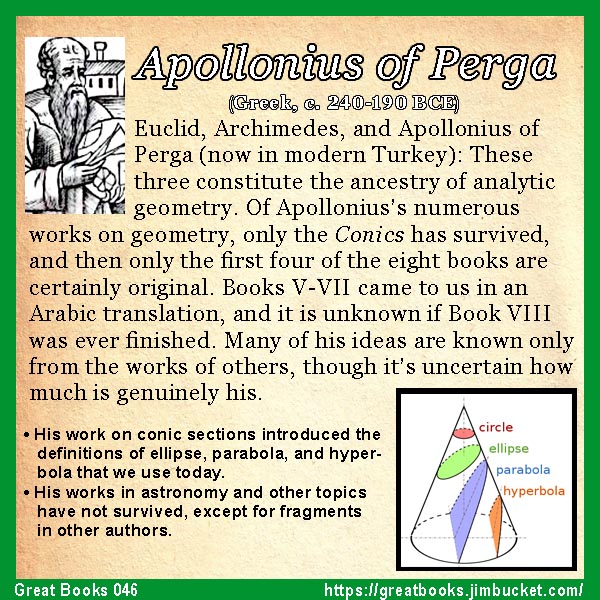
Euclid, Archimedes, and Apollonius of Perga (now in modern Turkey): These three constitute the ancestry of analytic geometry. Of Apollonius's numerous works on geometry, only the Conics has survived, and then only the first four of the eight books are certainly original. Books V-VII came to us in an Arabic translation, and it is unknown if Book VIII was ever finished. Many of his ideas are known only from the works of others, though it's uncertain how much is genuinely his.

  • His work on conic sections introduced the definitions of ellipse, parabola, and hyperbola that we use today.
  • His works in astronomy and other topics have not survived, except for fragments in other authors.


Navigation:

Monday, March 14, 2022

Zhuangzi

ZHUANGZI (Chinese, 369-286 BCE)

Zhuangzi (or Chuang Tzu) was a Chinese philosopher who, after reading "all the literature of his time," settled on Laozi as his fave, and became a founding philosopher of Daoism (Taoism). He was at least the primary, if not the sole, author of the 33-chapter work that bears his name, the Zhuangzi.

Two well-known stories about Zhuangzi:

  • Zhuangzi: "See how the fish come to the surface and swim where they like? That makes them happy."
    Huizi: "You are not a fish; how do you know what makes them happy?"
    Zhuangzi: "You are not me; how do you know I don't know what makes fish happy?"
  • Zhuangzi dreamed he was a butterfly. When he awoke, he didn't know if he was Zhuangzi who had dreamt he was a butterfly, or a butterfly dreaming that he was Zhuangzi.


Navigation:

Wednesday, March 9, 2022

Epicurus

EPICURUS (Greek; 341-270 BCE)

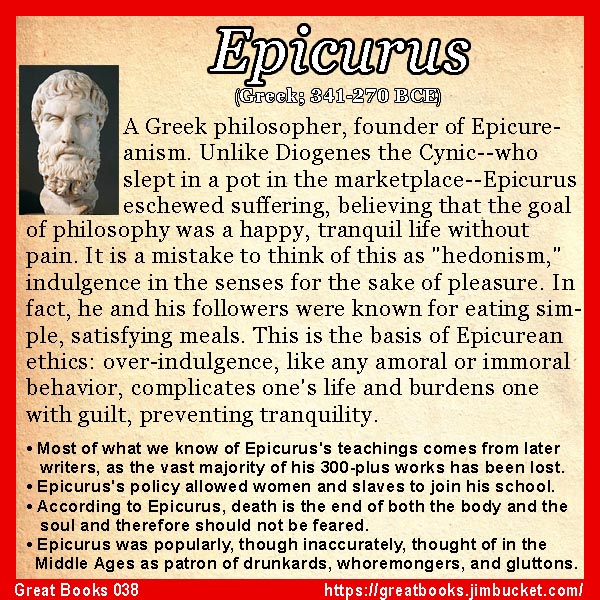
A Greek philosopher, founder of Epicureanism. Unlike Diogenes the Cynic--who slept in a pot in the marketplace--Epicurus eschewed suffering, believing that the goal of philosophy was a happy, tranquil life without pain. It is a mistake to think of this as "hedonism," indulgence in the senses for the sake of pleasure. In fact, he and his followers were known for eating simple, satisfying meals. This is the basis of Epicurean ethics: over-indulgence, like any amoral or immoral behavior, complicates one's life and burdens one with guilt, preventing tranquility.

  • Most of what we know of Epicurus's teachings comes from later writers, as the vast majority of his 300-plus works has been lost.
  • Epicurus's policy allowed women and slaves to join his school.
  • According to Epicurus, death is the end of both the body and the soul and therefore should not be feared.
  • Epicurus was popularly, though inaccurately, thought of in the Middle Ages as patron of drunkards, whoremongers, and gluttons.


Navigation:

Monday, March 7, 2022

Mencius (Mengzi)

MENCIUS (MENGZI) (Chinese, 372-289 BCE) 

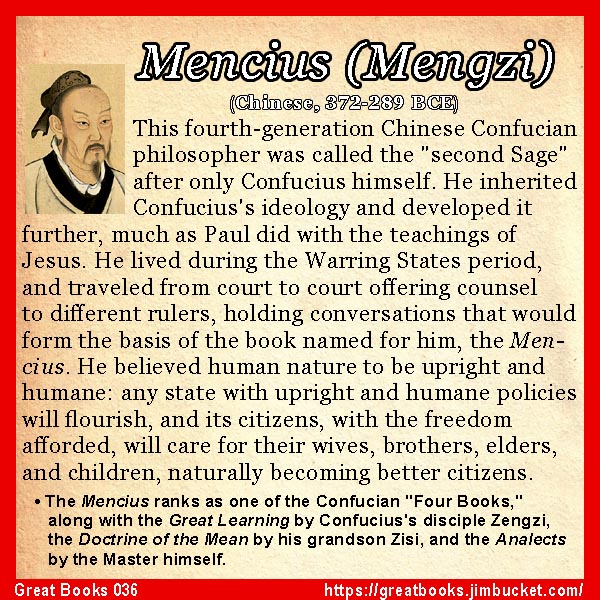
This fourth-generation Chinese Confucian philosopher was called the "second Sage" after only Confucius himself. He inherited Confucius's ideology and developed it further, much as Paul did with the teachings of Jesus. He lived during the Warring States period, and traveled from court to court offering counsel to different rulers, holding conversations that would form the basis of the book named for him, the Mencius. He believed human nature to be upright and humane: any state with upright and humane policies will flourish, and its citizens, with the freedom afforded, will care for their wives, brothers, elders, and children, naturally becoming better citizens.

  • The Mencius ranks as one of the Confucian "Four Books," along with the Great Learning by Confucius's disciple Zengzi, the Doctrine of the Mean by his grandson Zisi, and the Analects by the Master himself.


Navigation:

Sunday, March 6, 2022

Aristotle

ARISTOTLE (Greek, 384-322 BCE)

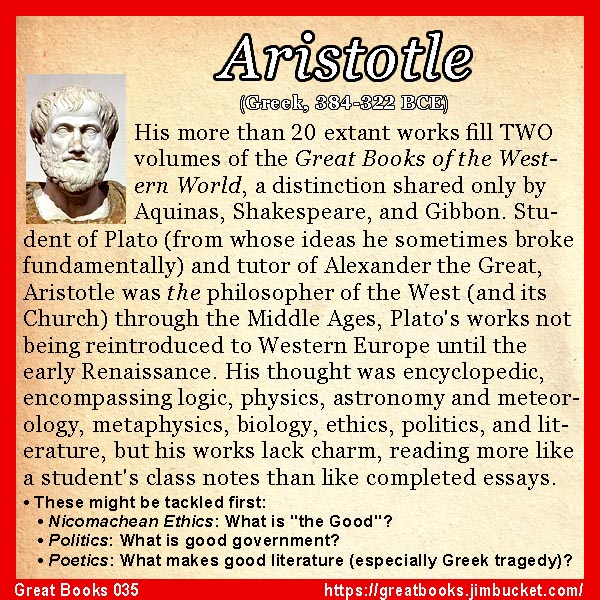
His more than 20 extant works fill TWO volumes of the Great Books of the Western World, a distinction shared only by Aquinas, Shakespeare, and Gibbon. Student of Plato (from whose ideas he sometimes broke fundamentally) and tutor of Alexander the Great, Aristotle was the philosopher of the West (and its Church) through the Middle Ages, Plato's works not being reintroduced to Western Europe until the early Renaissance. His thought was encyclopedic, encompassing logic, physics, astronomy and meteorology, metaphysics, biology, ethics, politics, and literature, but his works lack charm, reading more like a student's class notes than like completed essays.

  • These might be tackled first:
    •    Nicomachean Ethics: What is "the Good"?
    •    Politics: What is good government?
    •    Poetics: What makes good literature (especially Greek tragedy)?


Navigation:

Thursday, March 3, 2022

Diogenes the Cynic

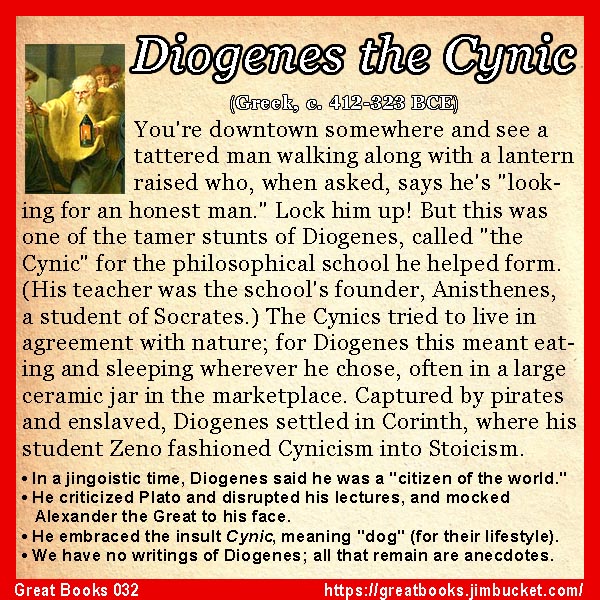
DIOGENES THE CYNIC (Greek, c. 412-323 BCE)

You're downtown somewhere and see a tattered man walking along with a lantern raised who, when asked, says he's "looking for an honest man." Lock him up! But this was one of the tamer stunts of Diogenes, called "the Cynic" for the philosophical school he helped form. (His teacher was the school's founder, Anisthenes, a student of Socrates.) The Cynics tried to live in agreement with nature; for Diogenes this meant eating and sleeping wherever he chose, often in a large ceramic jar in the marketplace. Captured by pirates and enslaved, Diogenes settled in Corinth, where his student Zeno fashioned Cynicism into Stoicism.

  • In a jingoistic time, Diogenes said he was a "citizen of the world."
  • He criticized Plato and disrupted his lectures, and mocked Alexander the Great to his face.
  • He embraced the insult Cynic, meaning "dog" (for their lifestyle).
  • We have no writings of Diogenes; all that remain are anecdotes.


Navigation:

Wednesday, March 2, 2022

Plato

PLATO (Greek, c. 428-348 BCE)

Modern British philosopher Alfred North Whitehead once stated: "the safest general characterization of the European philosophical tradition is that it consists of a series of footnotes to Plato." A student of Socrates, he is the most important philosopher in Western tradition; if that weren't enough, his most important student, Aristotle, was nearly as influential if not moreso. Born in Athens and founder of the Academy, he may have left us 35 dialogues and 13 letters (authorship of some is disputed), all of which have survived virtually intact. It's difficult to know how much of the material he attributes to Socrates is genuinely Socratic, and how much is his own; in the end it's best to focus on the words and not worry too much about which of these two great Athenians said them.


Navigation:

Tuesday, March 1, 2022

Xenophon of Athens


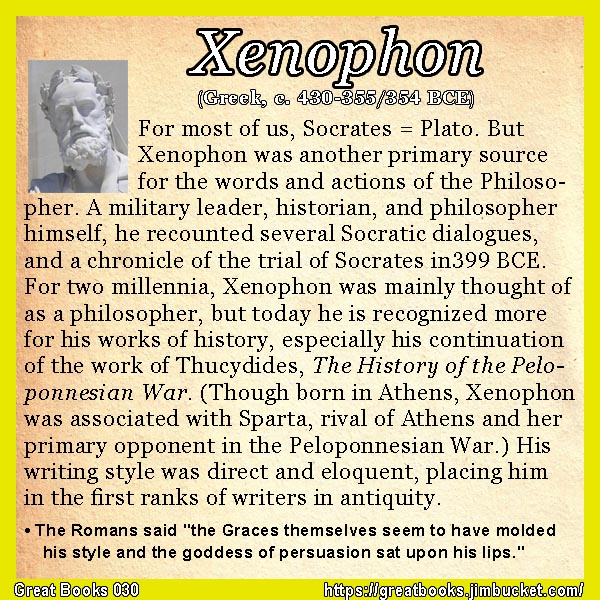
XENOPHON OF ATHENS (Greek, c. 430-355/354 BCE)

For most of us, Socrates = Plato. But Xenophon was another primary source for the words and actions of the Philosopher. A military leader, historian, and philosopher himself, he recounted several Socratic dialogues, and a chronicle of the trial of Socrates in 399 BCE. For two millennia, Xenophon was mainly thought of as a philosopher, but today he is recognized more for his works of history, especially his continuation of the work of Thucydides, The History of the Peloponnesian War. (Though born in Athens, Xenophon was associated with Sparta, rival of Athens and her primary opponent in the Peloponnesian War.) His writing style was direct and eloquent, placing him in the first ranks of writers in antiquity.

  • The Romans said "the Graces themselves seem to have molded his style and the goddess of persuasion sat upon his lips."


Navigation:

Wednesday, February 23, 2022

Zisi

ZISI (KONG JI) (Chinese Confucian philosopher, c. 481-402 BCE)

Zisi (also called Kong Ji) was the grandson of Confucius and is credited with writing the Doctrine of the Mean, one of the "Four Books" of classical Chinese philosophy (with the Great Learning, the Analects, and the Mencius). In just 33 chapters, Zisi demonstrates the usefulness of a "golden way" to gain perfect virtue. And what is that "way"? Some have translated the book's title, "Middle Way" or "Use of the Middle (Mean)." It is the principle of maintaining balance and harmony by developing in the mind a state of constant equilibrium. One should never act in excess, but practice self-examination, tolerance towards others, and sincerity.


Navigation:

Thursday, February 17, 2022

Laozi

LAOZI (Chinese, 6th-century BCE?)

Laozi (also Lao Tzu or Lao-Tze, meaning perhaps "Old Master") is the supposed author of the Dao De Jing (or Tao Te Ching) primary text of philosophical Daoism (Taoism). He is a god in religious Daoism. There is no proof of his earthly existence, but he is said to have been a slightly-older contemporary of Confucius. The Dao De Jing, then, may have been sayings compiled from various sources. Weary of the moral decay in the kingdom (they say), at 80 he rode west on an ox. As he passed the last gate of the kingdom, a sentry recognized him and asked him to at least leave his wisdom behind, so he wrote the Dao De Jing and rode on, never to be seen again (though some say he went to India and taught--or became--the Buddha).


Navigation:

Wednesday, February 16, 2022

Zengzi

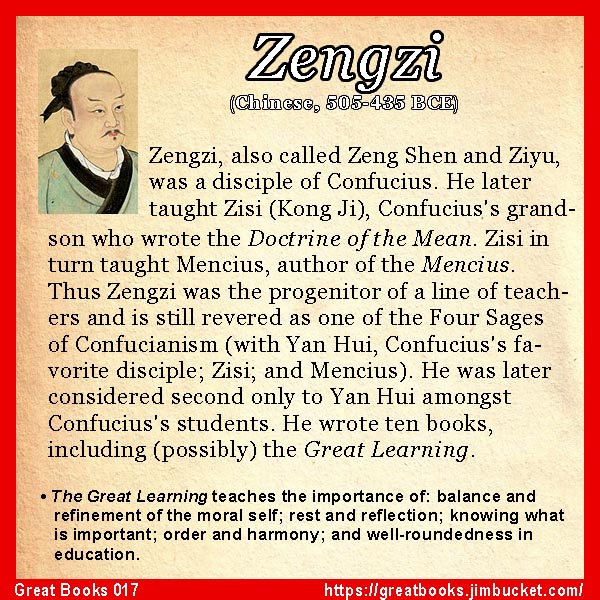
ZENGZI (Chinese, 505–435 BCE)

Zengzi, also called Zeng Shen and Ziyu, was a disciple of Confucius. He later taught Zisi (Kong Ji), Confucius's grandson who wrote the Doctrine of the Mean. Zisi in turn taught Mencius, author of the Mencius. Thus Zengzi was the progenitor of a line of teachers and is still revered as one of the Four Sages of Confucianism (with Yan Hui, Confucius's favorite disciple; Zisi; and Mencius). He was later considered second only to Yan Hui amongst Confucius's students. He wrote ten books, including (possibly) The Great Learning.

  • The Great Learning teaches the importance of: balance and refinement of the moral self; rest and reflection; knowing what is important; order and harmony; and well-roundedness in education.


Navigation: