Showing posts with label Scientist. Show all posts

Monday, May 2, 2022

Galen

GALEN (Greek, c. 129-216 CE)

Aelius (or Claudius) Galenus, called Galen or Galen of Pergamon, was a Greek physician, surgeon and philosopher from Pergamon (now in Turkey) in the days of the Roman Empire. He was one of the greatest medical researchers of antiquity, influencing anatomy, physiology, pathology, pharmacology, and neurology, as well as philosophy and logic. After receiving an education as a physician and philosopher, he traveled widely to study the medical lore of various places. He then settled in Rome, where he became personal physician to several emperors. Like Hippocrates, Galen based his practice on the theory of the "four humors," that the body had four "juices" (black bile, yellow bile, blood, and phlegm) that must be kept in balance. His studies in anatomy were based mainly on animal dissection, and were not seriously challenged until Vesalius in 1543. 


Navigation:

Wednesday, April 20, 2022

Ptolemy

PTOLEMY (Roman Greco-Egyptian, c. 100-170 CE)

Ptolemy (called Claudius Ptolemy to distinguish him from members of the Greco-Egyptian ruling dynasty that ended with Cleopatra VII in 30 BCE) was a Greco-Egyptian Roman citizen and a mathematician, astronomer, astrologer, geographer, and music theorist. He wrote about a dozen scientific treatises, three of which were of importance to later Byzantine, Islamic, and Western European science: the astronomical treatise now known as the Almagest; the Geography, a discussion on the geographic knowledge of the Greco-Roman world; and the astrological treatise attempting to adapt astrology to the Aristotelian natural philosophy of his day known as the Tetrábiblos or "Four Books." Ptolemy's writings were copied and commented upon throughout Antiquity and the Middle Ages.


Navigation:

Saturday, March 26, 2022

On the Nature of Things

ON THE NATURE OF THINGS (Lucretius, Roman, c. 99-55 BCE)

On the Nature of Things (De rerum natura) is the only known work of the Roman poet Lucretius (Titus Lucretius Carus, c. 99-55 BCE). It teaches the tenets and philosophy of Epicureanism to a Roman audience. Its 7400 lines are divided into six untitled books: it starts with atoms ("Nothing exists except atoms and the void") and their behavior; moves on to the nature of mind and soul; then sensation and thought; and finally the origin of the world, the motions of the planets, weather phenomena; etc. The world Lucretius describes operates according to physical principles ("laws"), guided by chance, without the intervention of the traditional Roman gods. The book was a major influence on Virgil, Horace, and other later poets. Nearly lost, it was rediscovered in a German monastery in 1417.


Navigation:

Tuesday, March 15, 2022

Archimedes

ARCHIMEDES (Greek, c. 287-212 BCE)

Archimedes was one of the ancient world's greatest scientists, mathematicians, and engineers. He was born in the then-Greek city of Syracuse, on Sicily; he died there around 75 years later as the Romans took the city: a Roman soldier killed its most famous son, despite explicit orders to spare him. The siege had been prolonged by weapons he designed to defend the city. His surviving works number around a dozen. One, The Sand Reckoner, addresses the question of how many grains of sand would fit inside the universe. His proudest achievement describes the relationship between spheres and cylinders.

  • It's claimed that Archimedes made a great discovery while in the bath, and in his excitement rose and ran through the streets naked shouting "Eureka!" ("I have found it!").
  • He is also alleged to have said something like, "Give me a lever and a place to stand and I will move the earth."
  • Seven of his works were rediscovered in a manuscript in 1906.


Navigation:

Saturday, February 26, 2022

Hippocrates

HIPPOCRATES (Greek, c. 460-370 BCE)

A Greek physician considered one of the most outstanding figures in the history of medicine, and traditionally referred to as the "Father of Medicine." His school established medicine as a discipline distinct from others (like magic and philosophy) and made it a profession. A modern version of the "Hippocratic Oath" (written originally by him or his followers) is still a legal requirement in some jurisdictions.

  • In the modern version of the "Hippocratic Oath" (which reflects the principles of the "original") the practitioner swears to:
    • respect and transmit the principles of science
    • apply the appropriate amount of treatment
    • remember the art as well as the science of medicine
    • be willing to say "I know not" and consult with colleagues
    • respect the privacy of patients
    • not play at God
    • remember the humanity of the patient
    • prevent disease whenever possible
    • be an upstanding member of society


Navigation:

Monday, February 21, 2022

Empedocles

EMPEDOCLES (Greek, c. 494-434 BCE)

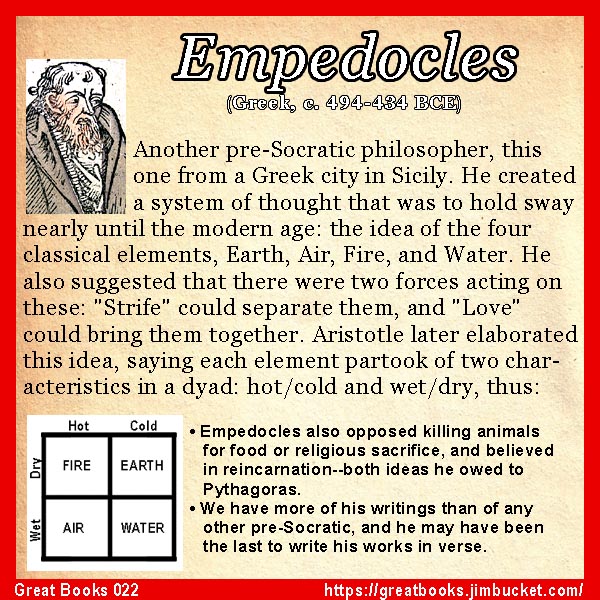
Another pre-Socratic philosopher, this one from a Greek city in Sicily. He created a system of thought that was to hold sway nearly until the modern age: the idea of the four classical elements, Earth, Air, Fire, and Water. He also suggested that there were two forces acting on these: "Strife" could separate them, and "Love" could bring them together. Aristotle later elaborated this idea, saying each element partook of two characteristics in a dyad: hot/cold and wet/dry, thus:

Fire: hot and dry
Air: hot and wet
Water: cold and wet
Earth: cold and dry
  • Empedocles also opposed killing animals for food or religious sacrifice, and believed in reincarnation--both ideas he owed to Pythagoras.
  • We have more of his writings than of any other pre-Socratic, and he may have been the last to write his works in verse.

Navigation:

Tuesday, February 8, 2022

Thales

THALES (Greek, c. 548/545 BCE)

Thales of Miletus, a pre-Socratic thinker from Asia Minor, was one of the "Seven Sages of Greece," and regarded as the first Greek philosopher by no less than Aristotle. As the "Father of Science" he abandoned mythology as an explanation for the world and attempted to explain its existence rationally. In his view, the original substance from which the world developed was water (other thinkers had other ideas). He calculated the heights of pyramids using geometry, and was the first known to have used deductive reasoning in geometry and to whom a mathematical discovery has been attributed.

  • Though lists vary, the "Seven Sages" were first given by Socrates in Plato's Protagoras as Thales of Miletus, Pittacus of Mytilene, Bias of Priene, Solon of Athens, Cleobulus of Lindus, Myson of Chenae, and Chilon of Sparta.
  • Heraclitus thought the world came from fire, Anaximenes from air, and Anaximander from "the boundless."


Navigation: