Showing posts with label Epic. Show all posts

Monday, May 16, 2022

The Mahabharata

THE MAHABHARATA (Vyasa?, Indian, before 200 CE)

The Mahabharata (meaning, perhaps, "The Great [Epic of] India") is one of the country's two great epics, the other being the Ramayana. The Mahabharata tells of a dynastic struggle between two groups of cousins, with a gambling game as the MacGuffin that gets the struggle going. The five Pandavas (our heroes) and their wife (it's complicated) lose to their Kaurava cousins (whom some believe cheated) and undergo 12 + 1 years of exile. Many folktales are incorporated into their years of wandering. The struggle at last comes to a head in the great 18-day Kurukshetra War (occupying 1/4 of the book), which the five Pandavas win (all surviving) though the moral complexity of slaughtering kin makes the victory somewhat hollow, a point we'll discuss when we reach the Bhagavad Gita, which is imbedded in this much larger work.

Navigation:

Monday, March 28, 2022

The Aeneid

THE AENEID (Virgil, Roman, 29-19 BCE)

Homer ends his epic story of Troy before the war is over--before the Trojan Horse. He then skips to the homeward journey of Odysseus. But how did things wrap up in Troy? That story comes to us in another, much later, epic by the Roman poet Virgil (or Vergil). His Aeneid tells the story of Aeneas, whose father was first cousin to King Priam of Troy, and who himself was ancestor to Romulus and Remus, (legendary) founders of Rome, as well as Brutus, (legendary) founder of Britain, and thus of King Arthur and others. Aeneas, like Odysseus, wanders for years--in the last one, he courts Queen Dido of Carthage--before undertaking the conquest of the Latins. It was the ancient Romans' national epic.

  • Before The Aeneid, Virgil also wrote the ten pastoral poems called the Eclogues, and the four books of the Georgics, a poem on agricultural matters.

Navigation:

Saturday, March 12, 2022

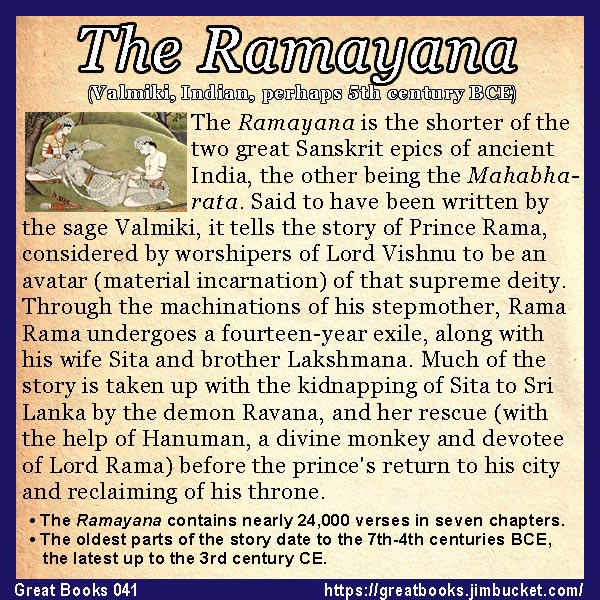
The Ramayana

THE RAMAYANA (Valmiki, Indian, perhaps 5th century BCE)

The Ramayana is the shorter of the two great Sanskrit epics of ancient India, the other being the Mahabharata. Said to have been written by the sage Valmiki, it tells the story of Prince Rama, considered by worshipers of Lord Vishnu to be an avatar (material incarnation) of that supreme deity. Through the machinations of his stepmother, Rama undergoes a fourteen-year exile, along with his wife Sita and brother Lakshmana. Much of the story is taken up with the kidnapping of Sita to Sri Lanka by the demon Ravana, and her rescue (with the help of Hanuman, a divine monkey and devotee of Lord Rama) before the prince's return to his city and reclaiming of his throne.

  • The Ramayana contains nearly 24,000 verses in seven chapters.
  • The oldest parts of the story date to the 7th-4th centuries BCE, the latest up to the 3rd century CE.


Navigation:

Saturday, February 5, 2022

The Odyssey

THE ODYSSEY (Homer, Greek, c. 8th century BCE)

A sort of sequel to The Iliad, Homer's Odyssey tells of the hero Odysseus, King of Ithaca, and his return home from the ten-year Trojan War. They wander the Mediterranean ten more years before Odysseus arrives home alone, having lost all his men. He meets the nymph Calypso, the drug-addled lotus-eaters, the Cyclops, cannibals, the witch Circe, the dangerously alluring Sirens, and the twin threats of Scylla and Charybdis. At home he finds that over 100 "suitors" have been vying for his "widow"--while eating him out of house and home. In a sub-plot, his son Telemachus had set out to search for him. In the end, father and son are re-united at Ithaca, slay the suitors, and restore balance to the kingdom.

  • It was "Clever Odysseus" who devised the ruse of the "Trojan Horse" that ended the Trojan War.


Navigation:

Friday, February 4, 2022

The Iliad

THE ILIAD (Homer, Greek, c. 8th century BCE)

Until the 19th century rediscovery of The Epic of Gilgamesh, Homer (whoever he was) was thought to be the author of the oldest epics in our literature. One, The Iliad, tells the story of "the Wrath of Achilles" when he is slighted during the Trojan War, the Greeks' ten-year siege of Troy (Ilium). The actual story covers only a few weeks during the war's final year. It tells neither the prelude to the war--the full story behind the kidnapping of Agamemnon's sister-in-law Helen by Prince Paris of Troy--nor its end, the famous episode of "The Trojan Horse."

  • King Agamemnon has chosen to return a woman taken as spoils of war, and in turn takes away one awarded to Achilles. This is where our story begins: "Sing, O goddess, the wrath of Achilles..."

Navigation:

Monday, January 31, 2022

The Epic of Gilgamesh

THE EPIC OF GILGAMESH (Mesopotamian, c. 2100 or 700 BCE)

The earliest epic known to literature is also a cracking good "buddy movie": Mesopotamian gods pair up arrogant King Gilgamesh with a "wild man" named Enkidu. Together they slay monsters--and offend the gods, leading to Enkidu's untimely death. This sends grieving Gil off on a search for immortality, which he finds--and loses again. In the end, he learns the importance of the best of human values.

  • Gilgamesh was likely a real king who ruled a Mesopotamian city in the 3rd millennium BCE.
  • His city was named "Uruk," from which we get the name of the modern country: Iraq.
  • The legends began shaping up around 2100 BCE, but weren't written down until around 1400 years later.


Navigation: