Showing posts with label Christian. Show all posts

Friday, May 27, 2022

The Nag Hammadi Library

THE NAG HAMMADI LIBRARY (Coptic Christian, 3rd-4th centuries CE)

In 1945 an Egyptian farmer found 13 leather-bound papyrus codices (similar to books, not scrolls) buried in a meter-high sealed jar in a cemetery, perhaps during a simple grave robbery. The finder at first feared the jar might contain a "genie," but when he realized there might be gold inside, he smashed it with gusto. He took the documents home and dumped them next to the oven; his mother admits to having used many pages for kindling. What remains are 52 treatises, most of them Gnostic texts (including the Gospel of Thomas). They were translated into Coptic, a late form of Egyptian, from earlier Greek manuscripts. The collection is named for the Upper (southern) Egyptian town near which it was found; it is currently housed in the Coptic Museum in Cairo, Egypt.


Navigation:

Thursday, May 26, 2022

Hilary of Poitiers

HILARY OF POITIERS (Roman Christian, c. 310-367)

Saint Hilary of Poitiers (actually Hilarius, a man's name meaning "happy") was a Bishop and a Doctor of the Church, sometimes called the "Hammer of the Arians" (and the "Athanasius of the West") for his staunch opposition to Arianism. After a solid pagan education, he was a married man and a father when he read the Bible and converted; his wife and daughter (Saint Abra) were baptized with him. The Christians of Poitiers unanimously elected him bishop in 350 or 353. Like Athanasius, he was exiled by an emperor (but only once, for four years), where he continued writing. The reason for his exile is unclear, but his hobby was getting other bishops condemned for heresy, so it may have been plain old enmity. He left numerous works of theology, history, and hymnody and is remembered in biographies, the names of churches, and as the patron saint of lawyers.


Navigation:

Wednesday, May 25, 2022

Athanasius I of Alexandria

ATHANASIUS I OF ALEXANDRIA (Alexandria, Roman Egypt, c. 297-373)

Athanasius I of Alexandria, also called the Great, the Confessor or, among Coptic Christians, the Apostolic, as well as "Athanasius Against the World," was a Greek church father, and the 20th Coptic Orthodox "pope" (bishop) of Alexandria. He was bishop off and on for 45 years; 17 of those spent in five exiles on the order of four different Roman emperors. As a theologian, he was the chief defender of Trinitarianism against Arianism, which taught that Jesus was not co-eternal with the Father but was created by him in time. With John Chrysostom, Basil the Great, and Gregory of Nazianzus, he is considered one of the four great Eastern Doctors of the Church by the Roman Catholics.

  • The name of Athanasius is often associated with a convoluted and redundant Trinitarian statement called the "Athanasian Creed," though he almost certainly had nothing to do with it.
  • He was also the first person to list the 27 books of the New Testament canon that is in use today.


Navigation:

Monday, May 23, 2022

The Ecclesiastical History

THE ECCLESIASTICAL HISTORY (Roman Christian, c. 320 CE)

The Ecclesiastical (Church) History by Eusebius (260 or 265-339) tells the history of Christianity from the time of Christ to nearly the time of the author, stopping sometime around 320, during the reign of Constantine, the first officially Christian Roman emperor and Eusebius's patron. Arranged chronologically into 10 books, it incorporates and thus preserves long portions of documents no longer available to us. Its value as history has been argued: some consider it accurate, and some think it little more than pro-Constantine propaganda. Nevertheless, it is the first such history of Christianity, and set the style for later works, earning Eusebius the title "Father of Church History." He also wrote Biblical commentaries, a life of Constantine, and other, lesser works of history, including a Chronicle purporting to give the history of each nation--Assyrians, Chaldeans, and so on up to the Romans--from more or less "the beginning" (the Hebrew Chronicle starts with Adam).


Navigation:

Friday, May 20, 2022

Anthony the Great

ANTHONY THE GREAT (Egyptian Christian, 251-356 CE)

Anthony the Great, also called "of Egypt," "the Abbot," "of the Desert," "the Hermit," etc. and "the Father of All Monks" (though he was actually not the first), was the best known of the so-called Desert Fathers, partly because of the biography of him written by St. Athanasius of Alexandria, a work which functioned as a PR pamphlet for the new-fangled practice of Christian monasticism. Legends say that he endured supernatural temptation in the desert, a motif common in depictions of him.

  • A story: A philosopher asked the illiterate Anthony: "Father, how can you be so happy without the comfort of books?" Anthony replied "My book is the nature of created things, and any time I want to read the words of God, the book is before me."


Navigation:

Tuesday, May 17, 2022

Cyprian of Carthage

CYPRIAN OF CARTHAGE (Roman Christian, c. 210-258 CE)

Cyprian (Thaschus Caecilius Cyprianus) was a bishop of Carthage, the once-Phoenician city in North Africa. Of Berber descent, he is considered a saint in both West and East. He was the greatest of Latin Christian writers in the West before the arrival of Jerome and Augustine, his most famous treatise being De Ecclesiae Catholicae Unitate ("On the Unity of the Catholic Church"). After receiving a classical education, he converted to Christianity and soon became a bishop. He was known for his his strong pastoral skills, firmness of faith, and eventual martyrdom by the sword.


Navigation:

Sunday, May 8, 2022

Origen of Alexandria

ORIGEN OF ALEXANDRIA (Roman Christian, c. 185-253 CE)

An early Christian theologian, Origen was born in Alexandria and spent the first half of his life there, until conflict with a jealous bishop, Demetrius, caused him to relocate to Caesarea. As a lad he tried to be martyred with his dad (who was beheaded), but Mom hid his clothes to keep him home (willing to die, but not to be embarrassed). He wrote about 2,000 theological treatises. Some consider him a "Church father," one of the greatest geniuses of the early church; but scurrilous charges by Demetrius--including that he castrated himself, and that he believed Satan could be redeemed--lessened his chances of universal acceptance. Being ordained by a friend, the bishop in another jurisdiction, caused Demetrius to accuse him of insubordination. Tortured by the Romans for his faith in 250--but never renouncing it--he died of his injuries a few years later.

  • On the First Principles was the first systematic exposition of Christian theology.
  • Contra Celsum was a point-by-point reply to a scathing attack by the Pagan philosopher Celsus.

Navigation:

Thursday, May 5, 2022

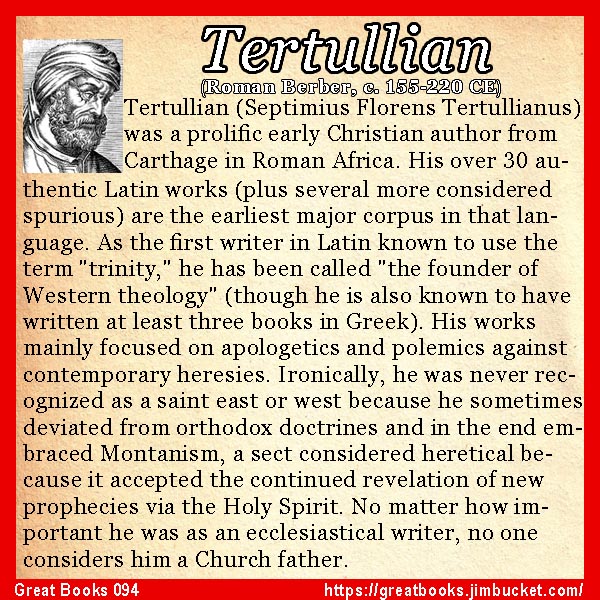
Tertullian

TERTULLIAN (Roman Berber, c. 155-220 CE)

Tertullian (Septimius Florens Tertullianus) was a prolific early Christian author from Carthage in Roman Africa. His over 30 authentic Latin works (plus several more considered spurious) are the earliest major corpus in that language. As the first writer in Latin known to use the term "trinity," he has been called "the founder of Western theology" (though he is also known to have written at least three books in Greek). His works mainly focused on apologetics and polemics against contemporary heresies. Ironically, he was never recognized as a saint east or west because he sometimes deviated from orthodox doctrines and in the end embraced Montanism, a sect considered heretical because it accepted the continued revelation of new prophecies via the Holy Spirit. No matter how important he was as an ecclesiastical writer, no one considers him a Church father.


Navigation:

Tuesday, May 3, 2022

Clement of Alexandria

CLEMENT OF ALEXANDRIA (Roman Christian, c. 150-215 CE)

Clement of Alexandria (Titus Flavius Clemens) was a Christian theologian and philosopher in Roman Alexandria, Egypt (though he may have been born at Athens and died at Jerusalem). Having been educated in classical Greek philosophy and literature, his three major works demonstrate greater influence by these disciplines than those of any other Christian thinker of his time. He may also have been familiar with pre-Christian Jewish esotericism and Gnosticism. Considered a Greek "Church Father," he left three works called a "trilogy":

  • The Protrepticus (The Exhortation), an attempt to evangelize the Greeks that includes a supposed history of Greek religion;
  • The Paedagogus (The Tutor), reflections on Christ's role in teaching humans to act morally and to control their passions; and
  • The Stromata (The Miscellanies), topics that spring up in the text like flowers in a meadow.


Navigation:

Wednesday, April 27, 2022

Justin Martyr

JUSTIN MARTYR (c. 100-165 CE)

In 165 a Christian apologist and six of his companions were beheaded for refusing to sacrifice to the gods in obedience to the emperor--who, at the time, was the Stoic Marcus Aurelius. So defining a moment was it that the act became a sort of "name": we now know him as Justin Martyr. (The word means "witness," but is used for people who die for their beliefs.) When he was young, he had tried on various philosophies--Stoic, Aristotelian, Pythagorean, Platonic--but none of them seemed to fit. At last he ran into an aged Christian who told him that the Prophets were more reliable than the philosophers; accepting this, he moved to Rome, where he took up the robe and profession of "philosopher," but teaching Christianity.

  • Though he is said to have written at least eight works, only two apologies and a dialogue survive.


Navigation:

Sunday, April 24, 2022

Irenaeus of Lyon

IRENAEUS OF LYON (Greek, c. 130-202 CE)

Irenaeus was a Greek bishop noted for guiding and expanding Christian communities in what is now southern France, as well as for his opposition to heresy and definitions of orthodoxy. He is said to have heard Polycarp preach, and Polycarp heard John the Evangelist, making Irenaeus the last-known living link with the Apostles. As bishop of Lugdunum (Lyon), he wrote a refutation of Gnosticism, especially as taught by Valentinus. He established three pillars of orthodoxy: the scriptures, the apostles' traditions, and the teachings of the apostles' successors. The surest source of Christian guidance, he said, is the Church of Rome, and he is the earliest to affirm the importance of the now-canonical gospels. He is the 37th and most recent (January 21, 2022) saint  to be named a Doctor of the Church.


Navigation:

Saturday, April 23, 2022

Extracanonical N.T. Books

EXTRACANONICAL N.T. BOOKS (2nd-5th centuries CE)

The so-called "New Testament apocrypha" are writings by early Christians that didn't "make the cut" to be included in the Bible. Many of these are pseudepigrapha, works that claim to be by an authority but are in fact anonymous. (Frankly, many of the canonical N.T. books are also pseudepigraphal.) The canon was "closed" with 27 books agreed on by almost all Christian sects; thus excluded are works in all the categories of the canonical works--"Gospels" of various sorts, including Infancy gospels; "Acts" of various "big names"; "Epistles," some by genuine church leaders and some fabricated; and some pretty wild Apocalypses.  Many of these works have theological axes to grind (like those of the Gnostics); some, though, make fascinating reading: try the Infancy Gospel of Thomas, where the boy Jesus brings clay birds to life and resurrects dead playmates.


Navigation:

Friday, April 22, 2022

The Christian Scriptures

THE CHRISTIAN SCRIPTURES (Greek/Jewish, perhaps  mid-to-late first century CE)

The so-called "New Testament" portion of The Holy Bible, focusing on the life and teachings of Jesus of Nazareth, called the Christ. It starts with four more or less biographical "Gospels," followed by a history of the early Church (Acts). Most of the rest is letters: 14 attributed to one Paul, each addressed to a local church or an individual; seven more called "Catholic epistles," meaning they're addressed to the Church in general; and finally the apocalyptic Book of Revelation, claiming to be a peek into the end of the world. The entire collection consists of 27 books (a list agreed on by virtually all Christian denominations), and follows the Hebrew Scriptures (or "Old Testament"), the structure of which varies between Judaism, Catholicism, and Protestantism.


Navigation:

Tuesday, April 19, 2022

Clement of Rome

CLEMENT OF ROME (Roman Christian, died 99 CE)

With Polycarp and Ignatius of Antioch, Clement of Rome is the third of the Three Great Apostolic Fathers of the Church. What's more, he was also Bishop of Rome, a post that is considered identical to that of Pope. Things are a bit fuzzy back then, but only St. Peter the Apostle and one or two others seem to have held the seat before him. We have one genuine letter from him, to the church at Corinth (called 1 Clement) in which he asserted the authority of "presbyters" (priests, the successors to the apostles), a major plank in the platform of papal power. A second epistle, called 2 Clement, is now thought to have been written by another author. Tradition says Clement was imprisoned under the Emperor Trajan, and executed by being tied to an anchor and thrown into the sea; he has become, naturally, a patron saint of mariners.


Navigation:

Monday, April 18, 2022

The Gospel of Thomas

THE GOSPEL OF THOMAS (2nd century CE)

By the mid-2nd century CE, the Christian church had settled on four gospels (Matthew, Mark, Luke, and John) as canonical. Since then their exclusive status has never been seriously challenged. But in the mid-20th century, a discovery of texts near Nag Hammadi, Egypt, rocked the theological world. Of the 52 mostly-Gnostic texts in the so-called Nag Hammadi library, one has become particularly well known: The Gospel of Thomas. Not a narrative of the life of Jesus, like the canonical gospels, it is a group of sayings of Jesus, many quite cryptic. Attributed to the Apostle Thomas, its real author is unknown; it is written in Coptic, a late form of Egyptian.

--------

Quotations:

  • "Split a piece of wood, and I am there. Lift up the stone, and you will find me there."
  • "He who knows the All but fails to know himself lacks everything."
  • "[T]he Kingdom of the Father is spread out upon the earth, and men do not see it."


Navigation:

Thursday, April 14, 2022

Polycarp of Smyrna

POLYCARP OF SMYRNA (69-155 CE)

"Saint" Polycarp was a Christian bishop of Smyrna (in modern Turkey). He died as a martyr (for refusing to burn incense to the Roman emperor) by being bound and burned at the stake, but when the fire failed to consume his body, he was stabbed. Several traditional churches consider him a saint and a Church Father. Irenaeus (another bishop from Smyrna, and a younger contemporary of Polycarp) and Tertullian (a Christian author born the year Polycarp died) say Polycarp was a direct disciple of the Apostle John, brother of James. The two-centuries-later (but much respected) writer Jerome said the same. With Clement of Rome and Ignatius of Antioch (who wrote him a letter on his way to his own martyrdom in Rome), Polycarp (the name means "fruitful") is regarded as one of three chief Apostolic Fathers.

  • Polycarp's sole surviving work, an Epistle to the Philippians, seems to derive mainly from other works, including some that would eventually be included in the Christian New Testament.


Navigation:

Tuesday, April 5, 2022

Ignatius of Antioch

IGNATIUS OF ANTIOCH (Roman, died c. 108/140 CE)

Ignatius was the Patriarch of Antioch and considered (with Clement of Rome and Polycarp) one of the three most important of the "Apostolic Fathers," church leaders in the first generations after the apostles of Jesus. Ignatius may have been a disciple of the Apostle John, the brother of James. He is generally believed to be the author of seven epistles to six churches (Ephesus, Magnesia, Tralles, Rome, Philadelphia, and Smyrna) and one colleague (Polycarp, bishop of Smyrna). He wrote these letters while being transported to Rome in chains for his eventual martyrdom. They address important topics like ecclesiology, the sacraments, and the role of bishops. A number of other, spurious, letters were later published in his name; these are referred to as the work of "Pseudo-Ignatius."


Navigation:

Saturday, March 19, 2022

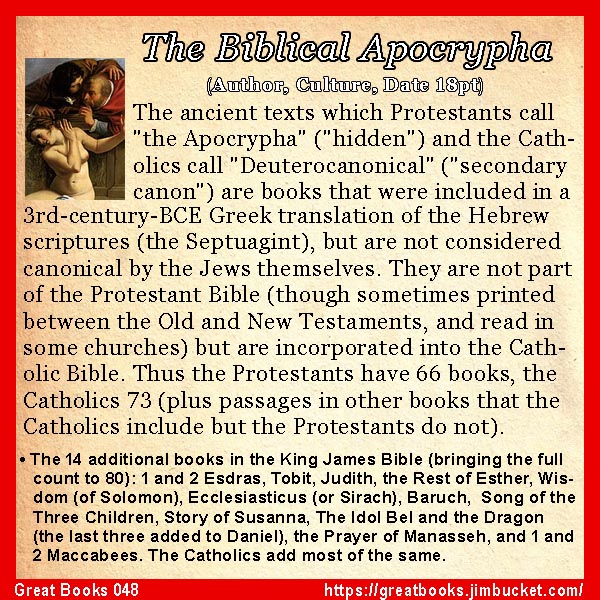
The Biblical Apocrypha

THE BIBLICAL APOCRYPHA (Jewish, c. 200 BCE-400 CE)

The ancient texts which Protestants call "the Apocrypha" ("hidden") and the Catholics call "Deuterocanonical" ("secondary canon") are books that were included in a 3rd-century-BCE Greek translation of the Hebrew scriptures (the Septuagint), but are not considered canonical by the Jews themselves. They are not part of the Protestant Bible (though sometimes printed between the Old and New Testaments, and read in some churches) but are incorporated into the Catholic Bible. Thus the Protestants have 66 books, the Catholics 73 (plus passages in other books that the Catholics include but the Protestants do not).

  • The 14 additional books in the King James Bible (bringing the full count to 80): 1 and 2 Esdras, Tobit, Judith, the Rest of Esther, Wisdom (of Solomon), Ecclesiasticus (or Sirach), Baruch, Song of the Three Children, Story of Susanna, The Idol Bel and the Dragon (the last three added to Daniel), the Prayer of Manasseh, and 1 and 2 Maccabees. The Catholics add most of the same.


Navigation: