Showing posts with label Egyptian. Show all posts

Friday, May 27, 2022

The Nag Hammadi Library

THE NAG HAMMADI LIBRARY (Coptic Christian, 3rd-4th centuries CE)

In 1945 an Egyptian farmer found 13 leather-bound papyrus codices (similar to books, not scrolls) buried in a meter-high sealed jar in a cemetery, perhaps during a simple grave robbery. The finder at first feared the jar might contain a "genie," but when he realized there might be gold inside, he smashed it with gusto. He took the documents home and dumped them next to the oven; his mother admits to having used many pages for kindling. What remains are 52 treatises, most of them Gnostic texts (including the Gospel of Thomas). They were translated into Coptic, a late form of Egyptian, from earlier Greek manuscripts. The collection is named for the Upper (southern) Egyptian town near which it was found; it is currently housed in the Coptic Museum in Cairo, Egypt.


Navigation:

Wednesday, May 25, 2022

Athanasius I of Alexandria

ATHANASIUS I OF ALEXANDRIA (Alexandria, Roman Egypt, c. 297-373)

Athanasius I of Alexandria, also called the Great, the Confessor or, among Coptic Christians, the Apostolic, as well as "Athanasius Against the World," was a Greek church father, and the 20th Coptic Orthodox "pope" (bishop) of Alexandria. He was bishop off and on for 45 years; 17 of those spent in five exiles on the order of four different Roman emperors. As a theologian, he was the chief defender of Trinitarianism against Arianism, which taught that Jesus was not co-eternal with the Father but was created by him in time. With John Chrysostom, Basil the Great, and Gregory of Nazianzus, he is considered one of the four great Eastern Doctors of the Church by the Roman Catholics.

  • The name of Athanasius is often associated with a convoluted and redundant Trinitarian statement called the "Athanasian Creed," though he almost certainly had nothing to do with it.
  • He was also the first person to list the 27 books of the New Testament canon that is in use today.


Navigation:

Friday, May 20, 2022

Anthony the Great

ANTHONY THE GREAT (Egyptian Christian, 251-356 CE)

Anthony the Great, also called "of Egypt," "the Abbot," "of the Desert," "the Hermit," etc. and "the Father of All Monks" (though he was actually not the first), was the best known of the so-called Desert Fathers, partly because of the biography of him written by St. Athanasius of Alexandria, a work which functioned as a PR pamphlet for the new-fangled practice of Christian monasticism. Legends say that he endured supernatural temptation in the desert, a motif common in depictions of him.

  • A story: A philosopher asked the illiterate Anthony: "Father, how can you be so happy without the comfort of books?" Anthony replied "My book is the nature of created things, and any time I want to read the words of God, the book is before me."


Navigation:

Monday, April 18, 2022

The Gospel of Thomas

THE GOSPEL OF THOMAS (2nd century CE)

By the mid-2nd century CE, the Christian church had settled on four gospels (Matthew, Mark, Luke, and John) as canonical. Since then their exclusive status has never been seriously challenged. But in the mid-20th century, a discovery of texts near Nag Hammadi, Egypt, rocked the theological world. Of the 52 mostly-Gnostic texts in the so-called Nag Hammadi library, one has become particularly well known: The Gospel of Thomas. Not a narrative of the life of Jesus, like the canonical gospels, it is a group of sayings of Jesus, many quite cryptic. Attributed to the Apostle Thomas, its real author is unknown; it is written in Coptic, a late form of Egyptian.

--------

Quotations:

  • "Split a piece of wood, and I am there. Lift up the stone, and you will find me there."
  • "He who knows the All but fails to know himself lacks everything."
  • "[T]he Kingdom of the Father is spread out upon the earth, and men do not see it."


Navigation:

Wednesday, February 2, 2022

The Egyptian Book of the Dead

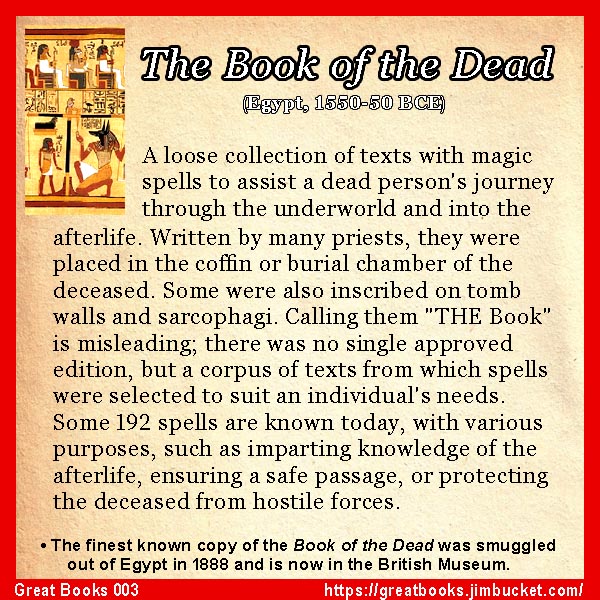
THE BOOK OF THE DEAD (Egypt, 1550-50 BCE)

A loose collection of texts with a number of magic spells to assist a dead person's journey through the underworld and into the afterlife. Written by many priests, they were placed in the coffin or burial chamber of the deceased. Some were also inscribed on tomb walls and sarcophagi. Calling them "THE Book" is misleading; there was no single approved edition, but a corpus of texts from which spells were selected to suit an individual's needs. Some 192 spells are known today, with various purposes, such as imparting knowledge of the afterlife, ensuring a safe passage, or protecting the deceased from hostile forces.

  • The finest known copy of the Book of the Dead was smuggled out of Egypt in 1888 and is now in the British Museum.

Navigation: