Showing posts with label Roman. Show all posts

Thursday, May 26, 2022

Hilary of Poitiers

HILARY OF POITIERS (Roman Christian, c. 310-367)

Saint Hilary of Poitiers (actually Hilarius, a man's name meaning "happy") was a Bishop and a Doctor of the Church, sometimes called the "Hammer of the Arians" (and the "Athanasius of the West") for his staunch opposition to Arianism. After a solid pagan education, he was a married man and a father when he read the Bible and converted; his wife and daughter (Saint Abra) were baptized with him. The Christians of Poitiers unanimously elected him bishop in 350 or 353. Like Athanasius, he was exiled by an emperor (but only once, for four years), where he continued writing. The reason for his exile is unclear, but his hobby was getting other bishops condemned for heresy, so it may have been plain old enmity. He left numerous works of theology, history, and hymnody and is remembered in biographies, the names of churches, and as the patron saint of lawyers.


Navigation:

Wednesday, May 25, 2022

Athanasius I of Alexandria

ATHANASIUS I OF ALEXANDRIA (Alexandria, Roman Egypt, c. 297-373)

Athanasius I of Alexandria, also called the Great, the Confessor or, among Coptic Christians, the Apostolic, as well as "Athanasius Against the World," was a Greek church father, and the 20th Coptic Orthodox "pope" (bishop) of Alexandria. He was bishop off and on for 45 years; 17 of those spent in five exiles on the order of four different Roman emperors. As a theologian, he was the chief defender of Trinitarianism against Arianism, which taught that Jesus was not co-eternal with the Father but was created by him in time. With John Chrysostom, Basil the Great, and Gregory of Nazianzus, he is considered one of the four great Eastern Doctors of the Church by the Roman Catholics.

  • The name of Athanasius is often associated with a convoluted and redundant Trinitarian statement called the "Athanasian Creed," though he almost certainly had nothing to do with it.
  • He was also the first person to list the 27 books of the New Testament canon that is in use today.


Navigation:

Monday, May 23, 2022

The Ecclesiastical History

THE ECCLESIASTICAL HISTORY (Roman Christian, c. 320 CE)

The Ecclesiastical (Church) History by Eusebius (260 or 265-339) tells the history of Christianity from the time of Christ to nearly the time of the author, stopping sometime around 320, during the reign of Constantine, the first officially Christian Roman emperor and Eusebius's patron. Arranged chronologically into 10 books, it incorporates and thus preserves long portions of documents no longer available to us. Its value as history has been argued: some consider it accurate, and some think it little more than pro-Constantine propaganda. Nevertheless, it is the first such history of Christianity, and set the style for later works, earning Eusebius the title "Father of Church History." He also wrote Biblical commentaries, a life of Constantine, and other, lesser works of history, including a Chronicle purporting to give the history of each nation--Assyrians, Chaldeans, and so on up to the Romans--from more or less "the beginning" (the Hebrew Chronicle starts with Adam).


Navigation:

Wednesday, May 18, 2022

The Six Enneads

THE SIX ENNEADS (Plotinus, Greek, c. 270 CE)

The Six Enneads ("groups of nine") are a collection of the writings of the Greek philosopher (born in Roman Alexandria, Egypt) named Plotinus (c. 204/5-270 CE), but compiled by his student Porphyry about the year of his death. With his teacher Ammonius Saccas, Plotinus was a founder of Neoplatonism (a label from the 19th century CE), a philosophical and religious system that extended the thought of Plato in a way that affected later Christian thinking. It focuses on three fundamental principles: the One (which "has its center everywhere but its circumference nowhere"), the Intellect (or nous, sometimes identified with God), and the Soul (an inner response to the nous).


Navigation:

Thursday, May 5, 2022

Tertullian

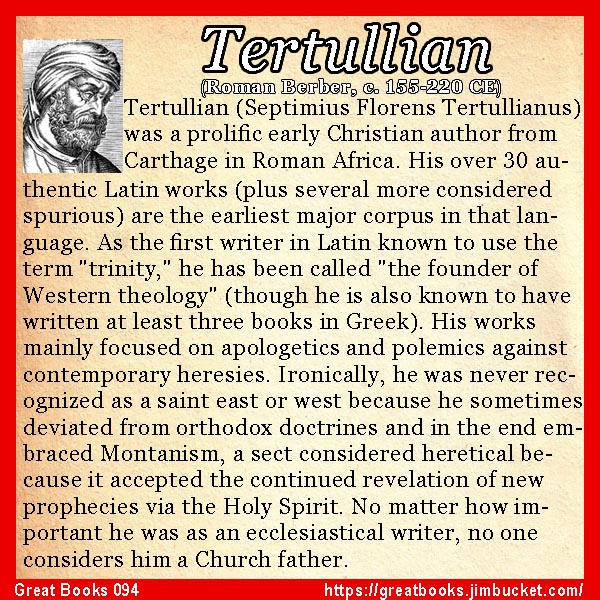
TERTULLIAN (Roman Berber, c. 155-220 CE)

Tertullian (Septimius Florens Tertullianus) was a prolific early Christian author from Carthage in Roman Africa. His over 30 authentic Latin works (plus several more considered spurious) are the earliest major corpus in that language. As the first writer in Latin known to use the term "trinity," he has been called "the founder of Western theology" (though he is also known to have written at least three books in Greek). His works mainly focused on apologetics and polemics against contemporary heresies. Ironically, he was never recognized as a saint east or west because he sometimes deviated from orthodox doctrines and in the end embraced Montanism, a sect considered heretical because it accepted the continued revelation of new prophecies via the Holy Spirit. No matter how important he was as an ecclesiastical writer, no one considers him a Church father.


Navigation:

Tuesday, May 3, 2022

Clement of Alexandria

CLEMENT OF ALEXANDRIA (Roman Christian, c. 150-215 CE)

Clement of Alexandria (Titus Flavius Clemens) was a Christian theologian and philosopher in Roman Alexandria, Egypt (though he may have been born at Athens and died at Jerusalem). Having been educated in classical Greek philosophy and literature, his three major works demonstrate greater influence by these disciplines than those of any other Christian thinker of his time. He may also have been familiar with pre-Christian Jewish esotericism and Gnosticism. Considered a Greek "Church Father," he left three works called a "trilogy":

  • The Protrepticus (The Exhortation), an attempt to evangelize the Greeks that includes a supposed history of Greek religion;
  • The Paedagogus (The Tutor), reflections on Christ's role in teaching humans to act morally and to control their passions; and
  • The Stromata (The Miscellanies), topics that spring up in the text like flowers in a meadow.


Navigation:

Monday, May 2, 2022

Galen

GALEN (Greek, c. 129-216 CE)

Aelius (or Claudius) Galenus, called Galen or Galen of Pergamon, was a Greek physician, surgeon and philosopher from Pergamon (now in Turkey) in the days of the Roman Empire. He was one of the greatest medical researchers of antiquity, influencing anatomy, physiology, pathology, pharmacology, and neurology, as well as philosophy and logic. After receiving an education as a physician and philosopher, he traveled widely to study the medical lore of various places. He then settled in Rome, where he became personal physician to several emperors. Like Hippocrates, Galen based his practice on the theory of the "four humors," that the body had four "juices" (black bile, yellow bile, blood, and phlegm) that must be kept in balance. His studies in anatomy were based mainly on animal dissection, and were not seriously challenged until Vesalius in 1543. 


Navigation:

Sunday, May 1, 2022

Lucian of Samosata

LUCIAN OF SAMOSATA (Hellenized Syrian, c. 125-after 180)

Lucian of Samosata was a wildly-popular satirist born in Samosata along the banks of the Euphrates in a part of the Roman province of Syria that is now in Turkey. He is best known for ridiculing superstition, religious practices, and belief in the paranormal. All we know of him comes from his own works (written in ancient Greek), but the "facts" are obscured by any literary license he may have taken--and his sarcasm. He may have been a successful travelling lecturer who settled down in Athens for a decade to write. More than 80 of his writings have survived, a huge number compared to other classical writers. His most famous work, A True Story, takes down authors who tell incredible tales. Lover of Lies contains the oldest known version of "The Sorcerer's Apprentice." His works affected later writers including Thomas More, Rabelais, Shakespeare, and Swift.


Navigation:

Friday, April 29, 2022

The Golden Ass

THE GOLDEN ASS (Apuleius, Roman, Late 2nd century CE)

(Lucius) Apuleius (c. 124-after 170 CE) was a Numidian--ethnically, a Berber--who lived in what is now Algeria. He wrote in Latin, and was a novelist and philosopher who studied and traveled in Athens, Italy, Asia Minor, and Egypt. He was initiated into several cults of the day. He is most famous for his bawdy picaresque novel, the Metamorphoses, better known as The Golden Ass, the only Latin novel that has survived in its entirety. It relates the ludicrous adventures of one Lucius, who experiments with magic, and, in trying to turn himself into a bird, ends up as a donkey. He goes through various adventures, encountering a number of tales set into the main narrative, before being turned back into a human by the goddess Isis. Interestingly, Lucius is also the author's first name, and the character comes from the author's hometown.


Navigation:

Thursday, April 28, 2022

The Meditations

THE MEDITATIONS (Marcus Aurelius, Roman, c. 161-180 CE?)

Not just any old writer, Marcus Aurelius was a Roman Emperor, counted among the "Five Good Emperors." He wrote down his thoughts while actively leading the empire; much of his book is believed to have been written while he was out in the field, making decisions about a military campaign. He was a Stoic philosopher, believing one should live a good life in accordance with nature, aligning one's decisions with the way things are. This was considered "virtue." Marcus was a "philosopher king," and The Meditations are worth reading over and over.

  • Marcus wrote: "If you are troubled by any external thing, it is not the thing that disturbs you, but your own attitude toward it. And it is in your power to change this attitude now." 
  • And: "Is a cucumber bitter? Throw it away. Are there briars in the road? Turn aside from them. This is enough. Do not add, 'And why were such things made in the world?'"


Navigation:

Wednesday, April 27, 2022

Justin Martyr

JUSTIN MARTYR (c. 100-165 CE)

In 165 a Christian apologist and six of his companions were beheaded for refusing to sacrifice to the gods in obedience to the emperor--who, at the time, was the Stoic Marcus Aurelius. So defining a moment was it that the act became a sort of "name": we now know him as Justin Martyr. (The word means "witness," but is used for people who die for their beliefs.) When he was young, he had tried on various philosophies--Stoic, Aristotelian, Pythagorean, Platonic--but none of them seemed to fit. At last he ran into an aged Christian who told him that the Prophets were more reliable than the philosophers; accepting this, he moved to Rome, where he took up the robe and profession of "philosopher," but teaching Christianity.

  • Though he is said to have written at least eight works, only two apologies and a dialogue survive.


Navigation:

Wednesday, April 20, 2022

Ptolemy

PTOLEMY (Roman Greco-Egyptian, c. 100-170 CE)

Ptolemy (called Claudius Ptolemy to distinguish him from members of the Greco-Egyptian ruling dynasty that ended with Cleopatra VII in 30 BCE) was a Greco-Egyptian Roman citizen and a mathematician, astronomer, astrologer, geographer, and music theorist. He wrote about a dozen scientific treatises, three of which were of importance to later Byzantine, Islamic, and Western European science: the astronomical treatise now known as the Almagest; the Geography, a discussion on the geographic knowledge of the Greco-Roman world; and the astrological treatise attempting to adapt astrology to the Aristotelian natural philosophy of his day known as the Tetrábiblos or "Four Books." Ptolemy's writings were copied and commented upon throughout Antiquity and the Middle Ages.


Navigation:

Saturday, April 16, 2022

Juvenal's Satires

JUVENAL'S SATIRES (1st-2nd centuries CE)

The Satires were written by Juvenal (Decimus Junius Juvenalis), a Roman poet of the late 1st and early 2nd century CE. Few details of his life are known with certainty; his dates are suggested by references in his text to people known to have lived at that time. His fifth and final book seems to have been written after 127. He wrote at least 16 poems (though the 16th is incomplete), published in five books, for a highly educated audience, satirizing life in the Rome of his day. Later translators have added titles to his works (he did not), such as "The Decay of Feminine Virtue" and "Wrong Desire is the Source of Suffering" (these are the titles of numbers VI and X, some of the most renowned in the collection).


Navigation:

Friday, April 15, 2022

The Twelve Caesars

THE TWELVE CAESARS (Roman, 121 CE)

De vita Caesarum (Latin, "About the Life of the Caesars") comprises 12 biographies of Julius Caesar and his 11 successors written by the Roman historian Suetonius (Gaius Suetonius Tranquillus, c. 69 to after 122 CE) in 121 CE, during the reign of the emperor Hadrian. It was Suetonius's best-seller (being Hadrian's personal secretary probably helped boost his sales). Considered significant in antiquity, it remains a primary source on Roman history, being often compared to the work of Tacitus. Suetonius also wrote other works, on the daily life of Rome, politics, and the lives of famous writers; most of these have been lost, but a few survive in fragments.

  • Suetonius's subjects, in order, were Julius Caesar, Augustus, Tiberius, Caligula, Claudius, Nero, Galba, Otho, Vitellius, Vespasian, and Titus.


Navigation:

Thursday, April 14, 2022

Polycarp of Smyrna

POLYCARP OF SMYRNA (69-155 CE)

"Saint" Polycarp was a Christian bishop of Smyrna (in modern Turkey). He died as a martyr (for refusing to burn incense to the Roman emperor) by being bound and burned at the stake, but when the fire failed to consume his body, he was stabbed. Several traditional churches consider him a saint and a Church Father. Irenaeus (another bishop from Smyrna, and a younger contemporary of Polycarp) and Tertullian (a Christian author born the year Polycarp died) say Polycarp was a direct disciple of the Apostle John, brother of James. The two-centuries-later (but much respected) writer Jerome said the same. With Clement of Rome and Ignatius of Antioch (who wrote him a letter on his way to his own martyrdom in Rome), Polycarp (the name means "fruitful") is regarded as one of three chief Apostolic Fathers.

  • Polycarp's sole surviving work, an Epistle to the Philippians, seems to derive mainly from other works, including some that would eventually be included in the Christian New Testament.


Navigation:

Wednesday, April 13, 2022

Pliny the Younger

PLINY THE YOUNGER (Roman, 61-113 CE)

Gaius Plinius Caecilius Secundus is called Pliny the Younger because his uncle (not his father) was Pliny the Elder. In fact the Elder played a closer-than-usual avuncular role when the boy's father died and, not unusually, he came under the care of his mother's brother. In 79 CE Mount Vesuvius erupted (burying the town of Pompeii), and the Elder was killed trying to make observations of the volcano's effect (and also to rescue victims). The Younger was at that time just 18, and his uncle left him his estate, while in the same will formally adopting him. He was a lawyer, author, and magistrate of Rome who wrote hundreds of letters; 247, of great historical value, survive, including some addressed to reigning emperors or to famous men like the historian Tacitus.


Navigation:

Tuesday, April 12, 2022

Nicomachus of Gerasa

NICHOMACHUS OF GERASA (Greco-Roman, c. 60-120 CE)

The medieval school curriculum, called "the seven liberal arts," was divided into two parts: the lower division was called the "trivium" (grammar, logic, and rhetoric); the upper was the "quadrivium" consisting of arithmetic, geometry, music, and astronomy). This division indicates that math, music, and the celestial motions were considered of a piece, and it seems one expert on these was the Greco-Roman scholar Nicomachus of Gerasa (in northern Jordan). He wrote an Introduction to Arithmetic and a Manual of Harmonics in Greek; as a Neopythagorean he also wrote about the mystical properties of numbers. Little else is known about him, but it is believed that he wrote the Manual at the request of a lady of noble birth, to whom it is addressed. This suggests he was a respected scholar of some status.


Navigation:

Monday, April 11, 2022

Tacitus

TACITUS (Roman, c. 56-120 CE)

Modern scholars consider Publius Cornelius Tacitus to be one of the greatest of Roman historians; he was also a politician. What we have of his two major works--the Annals and the Histories--cover the reigns of the Roman emperors Tiberius, Claudius, Nero, and the so-called "Four Emperors" who reigned in 69 CE (Galba, Otho, Vitellius, and Vespasian). Thus, they cover the time between the deaths of Augustus in 14 CE and Domitian in 96, though a number of gaps exist in what has survived. He wrote other, lesser, works too, but is noted by some for his early mention of the persecution of Christians at Rome and the earliest authenticated extra-Biblical reference to the crucifixion of Jesus.

  • We know few details about Tacitus's personal life; some of what we know comes from the letters of his friend and admirer Pliny the Younger.


Navigation:

Sunday, April 10, 2022

Epictetus

EPICTETUS (Greek, c. 50-135 CE)

The Stoic philosopher Epictetus, though born into slavery (in present day Turkey), was given permission by his master to study philosophy, which elevated his social status. At some point he became disabled--perhaps, it is reported, because his leg was deliberately broken by his master, but other sources say it had been that way from childhood. He gained his freedom some time after 68 CE and began to teach in Rome. In 93, when Emperor Domitian banished all philosophers from Rome, Epictetus moved to Greece and founded a school of philosophy.

  • Though Epictetus left no known writings, his student Arrian wrote down his teachings and published them in his Discourses and Enchiridion
  • Like most Stoics, Epictetus taught that philosophy is a way of life, not simply a theoretical discipline. We cannot control events, but we can control how we react to them. We are, however, responsible for our own actions.


Navigation:

Saturday, April 9, 2022

Plutarch's Parallel Lives

PARALLEL LIVES (Plutarch, Greco-Roman, c. 100 CE)

Plutarch's Parallel Lives of the Noble Greeks and Romans comprises 23 pairs of biographies. Each one pairs a leading Greek with a similar Roman, such as Alexander the Great and Julius Caesar. After each pair he usually appends an essay comparing the two (or in one case, a grouping of four). In addition to the pairs, two more unpaired names are usually added, plus two from a previous set of biographies, making 50 in all.

  • Plutarch himself was a Greek philosopher, historian, biographer, and priest at the Temple of Apollo in Delphi, born in the Roman era (c. 46-after 119 CE).
  • The average reader would recognize many of these names, like Theseus, Romulus, Solon, Pericles, Pompey, Cicero, Mark Anthony, Brutus, and others.
  • The Lives are Plutarch's second biographical work; only fragments survive of the first, Lives of the Roman Emperors.
  • Plutarch wrote another well-known work, the Moralia, a collection of essays and speeches.


Navigation: