Showing posts with label Dramatist. Show all posts

Wednesday, May 11, 2022

Shudraka

SHUDRAKA (Indian, unk. date, perhaps 3rd or 5th century CE)

Three extant Sanskrit plays are attributed to one Shudraka, who may have been a king (perhaps in the Abhira dynasty, which lasted from 203-315 or 370 CE), or could be a mythical figure. But the plays are real:

  • Mrichchhakatika (The Little Clay Cart), a ten-act drama in which a noble but impoverished young Brahmin (priest) falls in love with a wealthy courtesan, but their relationship is threatened by an aggressive rival.
  • Vinavasavadatta, a nine-act play (only eight survive) in which a king tries to "match" his daughter with another king; when the prospective groom refuses, the father imprisons him to break his pride--and it works!
  • Padmaprabhritaka, a bhana--a short one-act monologue in which one actor may take many parts.


Navigation:

Sunday, April 17, 2022

The Buddhacharita

THE BUDDHACHARITA (Sanskrit, early 2nd century CE)

The Buddhist monk Ashvaghosha (c. 80-150 CE) was born in northern India, and is believed to have been the first Sanskrit dramatist; but today he is best remembered for the Buddhacharita or "Acts of the Buddha," an epic poem written in Sanskrit (previous Buddhist works had largely used Pali or another vernacular of Sanskrit) in the early second century CE on the life of Gautama Buddha. Only the first half survives complete in Sanskrit (fragments of the latter half remain), but Chinese and Tibetan translations were made early on. Dealing with the "miracles" in a restrained style (for the time at least) he tells of the Buddha's birth and youth, his flight, austerities and training, enlightenment, life with his followers, and death.


Navigation:

Saturday, April 2, 2022

Seneca

SENECA (Roman, c. 4 BCE-65 CE)

The Roman writer Lucius Annaeus Seneca, also called "Seneca the Younger" or simply "Seneca," was wrapped up with the imperial family: he was tutor and advisor to Nero, who later ordered him to kill himself. (The Younger's father, the Elder, wrote books on rhetoric and history.) Seneca was so versatile a writer that until the 16th century it was normal to think of him as two separate people: Seneca the moral philosopher and Seneca the dramatist. His Stoic writings, such as the Naturales Quaestiones, are orthodox, but his plays are filled with intense emotions and have a grim overall tone--the antithesis of Stoicism. Tradition attributes 10 plays to Seneca; it seems likely only eight are actually from his hand.

  • His best-known plays are about Medea, who killed her own children; Thyestes, who unknowingly ate his own children; and Phaedra, who lusted after her stepson. Talk about family drama.

Navigation:

Tuesday, March 22, 2022

Terence, Roman African playwright

TERENCE (Roman, c. 195/185-159? BCE)

This Roman African playwright (who wrote six comedies) was actually Publius Terentius Afer; his last name indicates that he may well have been born in Africa, perhaps Carthage or the Roman province that is now Tunisia. Or not. Further, it is said that his mother may have been a slave. None of this suggests that he was of Black ancestry, as "slavery" and "Roman Africa" didn't necessarily mean any such thing at the time. It is almost certain that he himself was a slave; his owner, a Roman senator, had him educated and then, impressed by his talent, granted his freedom. He died around age 25, due either to shipwreck or disease.

  • The Latin of Terence's plays was so conversational that they were used for teaching that language in the Middle Ages and the Renaissance.
  • Shakespeare imitated some of Terence's plots, which he in turn had borrowed from the Greeks.


Navigation:

Monday, March 21, 2022

Bhasa

BHASA (Indian, before the 1st century BCE)

Although his dates are very uncertain, the great Indian playwright Bhasa was already well-known by the 1st century BCE; at the earliest, he lived in the later days of the Mauryan Empire (322-185 BCE). Thirteen plays have been connected to him, but were all lost until manuscripts were rediscovered around 1910. Bhasa's plays are generally short compared to later Indian plays. Three of those plays are based on the Ramayana, and seven on the Mahabharata. Another is a fairy tale, and two are based on the life of a legendary king who lived at the time of the Buddha. Two of his plays are the only known tragedies written in Sanskrit in ancient India; later, the guidelines for plays considered sad endings inappropriate.


Navigation:

Friday, March 18, 2022

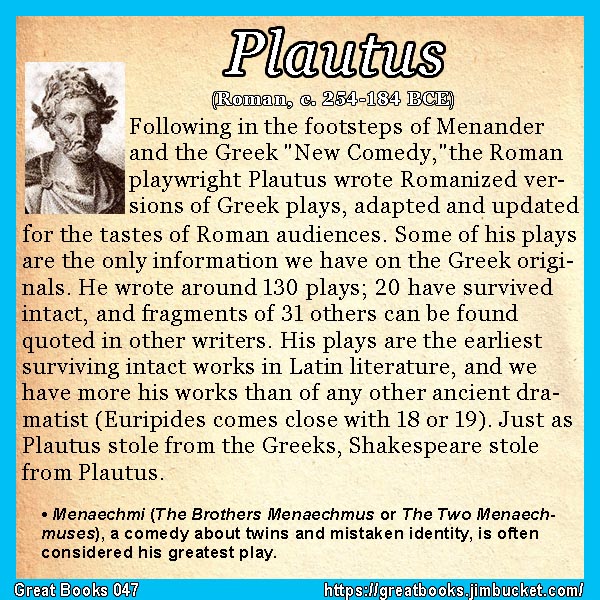
Plautus

PLAUTUS (Roman, c. 254-184 BCE)

Following in the footsteps of Menander and the Greek "New Comedy," the Roman playwright Plautus wrote Romanized versions of Greek plays, adapted and updated for the tastes of Roman audiences. Some of his plays are the only information we have on the Greek originals. He wrote around 130 plays; 20 have survived intact, and fragments of 31 others can be found quoted in other writers. His plays are the earliest surviving intact works in Latin literature, and we have more his works than of any other ancient dramatist (Euripides comes close with 18 or 19). Just as Plautus stole from the Greeks, Shakespeare stole from Plautus.

  • Menaechmi (The Brothers Menaechmus or The Two Menaechmuses), a comedy about twins and mistaken identity, is often considered his greatest play.


Navigation:

Tuesday, March 8, 2022

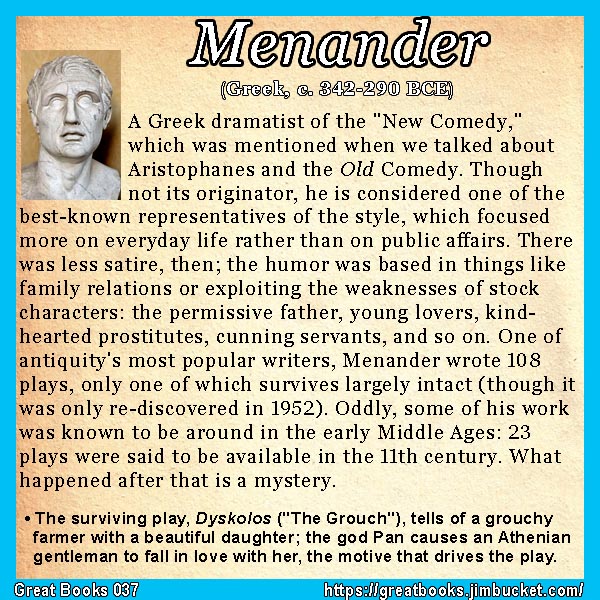
Menander

MENANDER (Greek, c. 342-290 BCE)

A Greek dramatist of the "New Comedy," which was mentioned when we talked about Aristophanes and the Old Comedy. Though not its originator, he is considered one of the best-known representatives of the style, which focused more on everyday life rather than on public affairs. There was less satire, then; the humor was based in things like family relations or exploiting the weaknesses of stock characters: the permissive father, young lovers, kind-hearted prostitutes, cunning servants, and so on. One of antiquity's most popular writers, Menander wrote 108 plays, only one of which survives largely intact (though it was only re-discovered in 1952). Oddly, some of his work was known to be around in the early Middle Ages: 23 plays were said to be available in the 11th century. What happened after that is a mystery.

  • The surviving play, Dyskolos ("The Grouch"), tells of a grouchy farmer with a beautiful daughter; the god Pan causes an Athenian gentleman to fall in love with her, the motive that drives the play.


Navigation:

Monday, February 28, 2022

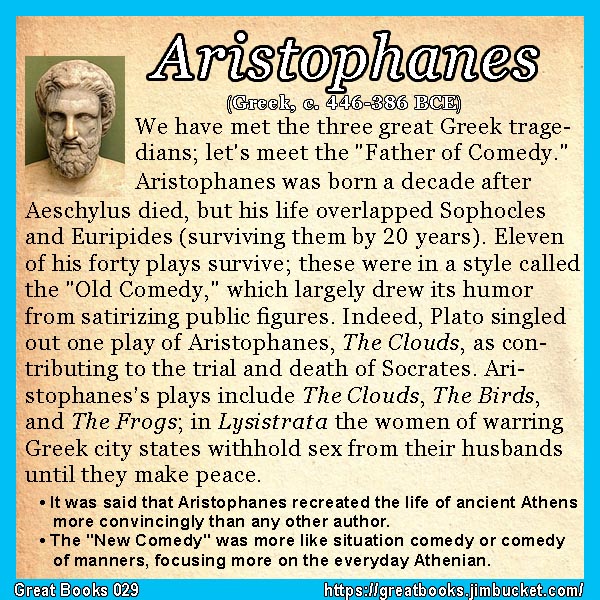
Aristophanes

ARISTOPHANES (Greek, c. 446-386 BCE)

We have met the three great Greek tragedians; let's meet the "Father of Comedy." Aristophanes was born a decade after  Aeschylus died, but his life overlapped Sophocles and Euripides (surviving them by 20 years). Eleven of his forty plays survive; these were in a style called the "Old Comedy," which largely drew its humor from satirizing public figures. Indeed, Plato singled out one play of Aristophanes, The Clouds, as contributing to the trial and death of Socrates.  Aristophanes's plays include The Clouds, The Birds, and The Frogs; in Lysistrata the women of warring Greek city states withhold sex from their husbands until they make peace.

  • It was said that Aristophanes recreated the life of ancient Athens more convincingly than any other author.
  • The "New Comedy" was more like situation comedy or comedy of manners, focusing more on the everyday Athenian.


Navigation:

Thursday, February 24, 2022

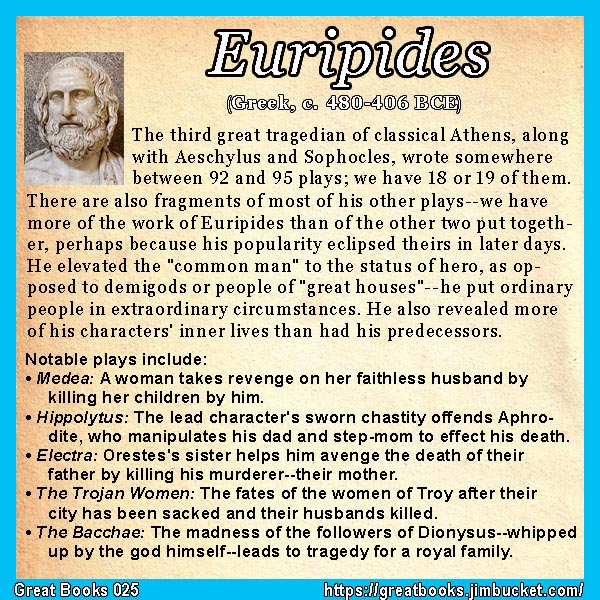
Euripides

EURIPIDES (Greek, c. 480-406 BCE)

The third great tragedian of classical Athens, along with Aeschylus and Sophocles, wrote somewhere between 92 and 95 plays; we have 18 or 19 of them. There are also fragments of most of his other plays--we have more of the work of Euripides than of the other two put together, perhaps because his popularity eclipsed theirs in later days. He elevated the "common man" to the status of hero, as opposed to demigods or people of "great houses"--he put ordinary people in extraordinary circumstances. He also revealed more of his characters' inner lives than had his predecessors.

--------

  • Notable plays include:
    • Medea: A woman takes revenge on her faithless husband by killing her children by him.
    • Hippolytus: The lead character's sworn chastity offends Aphrodite, who manipulates his dad and step-mom to effect his death.
    • Electra: Orestes's sister helps him avenge the death of their father by killing his murderer--their mother.
    • The Trojan Women: The fates of the women of Troy after their city has been sacked and their husbands killed.
    • The Bacchae: The madness of the followers of Dionysus--whipped up by the god himself--leads to tragedy for a royal family.


Navigation:

Sunday, February 20, 2022

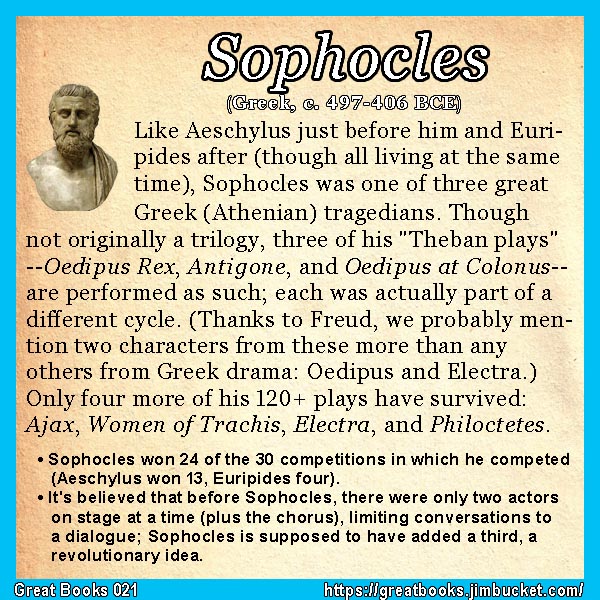
Sophocles

SOPHOCLES (Greek, c. 497-406 BCE)

Like Aeschylus just before him and Euripides after (though all living at the same time), Sophocles was one of three great Greek (Athenian) tragedians. Though they were not originally a trilogy, three of his "Theban plays"--Oedipus Rex, Antigone, and Oedipus at Colonus--are performed as such; each was actually part of a different cycle. (Thanks to Freud, we probably mention two characters from these more than any others from Greek drama: Oedipus and Electra.) Only four more of his 120+ plays have survived: Ajax, Women of Trachis, Electra, and Philoctetes.

  • Sophocles won 24 of the 30 competitions in which he competed (Aeschylus won 13, Euripides four).
  • It's believed that before Sophocles, there were only two actors on stage at a time (plus the chorus), limiting conversations to a dialogue; Sophocles is supposed to have added a third, a revolutionary idea.


Navigation:

Monday, February 14, 2022

Aeschylus

AESCHYLUS (Greek, c. 525-456 BCE)

The earliest of the three well-known ancient Greek tragedians (though their lives overlapped), he is called (naturally) the "father of tragedy." He wrote 70-90 plays, of which only seven survive. Among these, The Oresteia (Agamemnon, The Choephoroe, and The Eumenides) is the only ancient Greek trilogy--a form he may have introduced, and which became standard--to survive. It tells the violent story of the family of Agamemnon, centering on Agamemnon and Clytemnestra's son Orestes. His other extant plays are The Persians, Seven Against Thebes, The Suppliants, and Prometheus Bound (though some scholars think the last may have been written by his son Euphorion).


Navigation: