Showing posts with label Mathematician. Show all posts

Wednesday, April 20, 2022

Ptolemy

PTOLEMY (Roman Greco-Egyptian, c. 100-170 CE)

Ptolemy (called Claudius Ptolemy to distinguish him from members of the Greco-Egyptian ruling dynasty that ended with Cleopatra VII in 30 BCE) was a Greco-Egyptian Roman citizen and a mathematician, astronomer, astrologer, geographer, and music theorist. He wrote about a dozen scientific treatises, three of which were of importance to later Byzantine, Islamic, and Western European science: the astronomical treatise now known as the Almagest; the Geography, a discussion on the geographic knowledge of the Greco-Roman world; and the astrological treatise attempting to adapt astrology to the Aristotelian natural philosophy of his day known as the Tetrábiblos or "Four Books." Ptolemy's writings were copied and commented upon throughout Antiquity and the Middle Ages.


Navigation:

Tuesday, April 12, 2022

Nicomachus of Gerasa

NICHOMACHUS OF GERASA (Greco-Roman, c. 60-120 CE)

The medieval school curriculum, called "the seven liberal arts," was divided into two parts: the lower division was called the "trivium" (grammar, logic, and rhetoric); the upper was the "quadrivium" consisting of arithmetic, geometry, music, and astronomy). This division indicates that math, music, and the celestial motions were considered of a piece, and it seems one expert on these was the Greco-Roman scholar Nicomachus of Gerasa (in northern Jordan). He wrote an Introduction to Arithmetic and a Manual of Harmonics in Greek; as a Neopythagorean he also wrote about the mystical properties of numbers. Little else is known about him, but it is believed that he wrote the Manual at the request of a lady of noble birth, to whom it is addressed. This suggests he was a respected scholar of some status.


Navigation:

Thursday, March 17, 2022

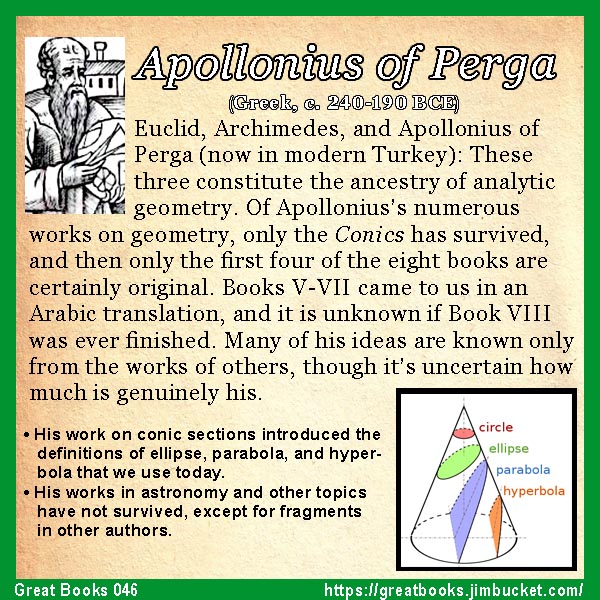
Apollonius of Perga

APOLLONIUS OF PERGA (Greek, c. 240-190 BCE)

Euclid, Archimedes, and Apollonius of Perga (now in modern Turkey): These three constitute the ancestry of analytic geometry. Of Apollonius's numerous works on geometry, only the Conics has survived, and then only the first four of the eight books are certainly original. Books V-VII came to us in an Arabic translation, and it is unknown if Book VIII was ever finished. Many of his ideas are known only from the works of others, though it's uncertain how much is genuinely his.

  • His work on conic sections introduced the definitions of ellipse, parabola, and hyperbola that we use today.
  • His works in astronomy and other topics have not survived, except for fragments in other authors.


Navigation:

Tuesday, March 15, 2022

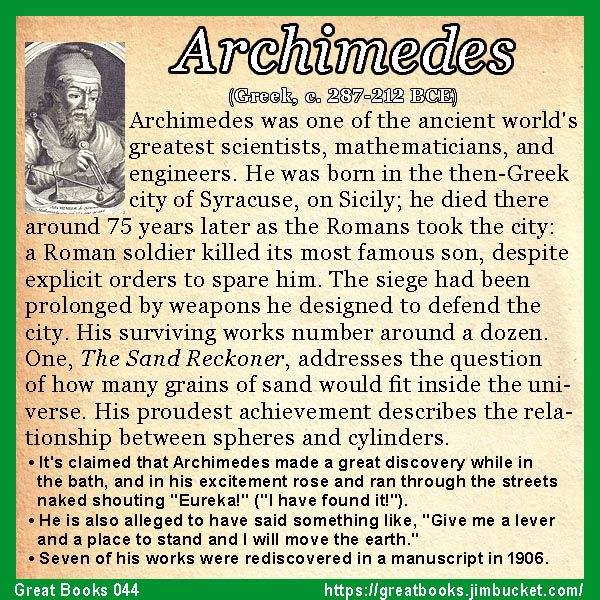
Archimedes

ARCHIMEDES (Greek, c. 287-212 BCE)

Archimedes was one of the ancient world's greatest scientists, mathematicians, and engineers. He was born in the then-Greek city of Syracuse, on Sicily; he died there around 75 years later as the Romans took the city: a Roman soldier killed its most famous son, despite explicit orders to spare him. The siege had been prolonged by weapons he designed to defend the city. His surviving works number around a dozen. One, The Sand Reckoner, addresses the question of how many grains of sand would fit inside the universe. His proudest achievement describes the relationship between spheres and cylinders.

  • It's claimed that Archimedes made a great discovery while in the bath, and in his excitement rose and ran through the streets naked shouting "Eureka!" ("I have found it!").
  • He is also alleged to have said something like, "Give me a lever and a place to stand and I will move the earth."
  • Seven of his works were rediscovered in a manuscript in 1906.


Navigation:

Friday, March 11, 2022

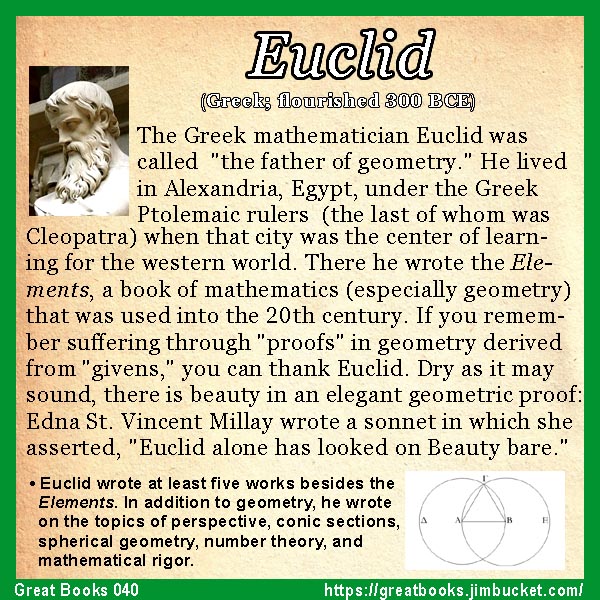
Euclid

EUCLID (Greek; flourished 300 BCE)

The Greek mathematician Euclid was called "the father of geometry." He lived in Alexandria, Egypt, under the Greek Ptolemaic rulers (the last of whom was Cleopatra) when that city was the center of learning for the western world. There he wrote the Elements, a book of mathematics (especially geometry) that was used into the 20th century. If you remember suffering through "proofs" in geometry derived from "givens," you can thank Euclid. Dry as it may sound, there is beauty in an elegant geometric proof: Edna St. Vincent Millay wrote a sonnet in which she asserted, "Euclid alone has looked on Beauty bare."

  • Euclid wrote at least five works besides the Elements. In addition to geometry, he wrote on the topics of perspective, conic sections, spherical geometry, number theory, and mathematical rigor.


Navigation:

Thursday, February 10, 2022

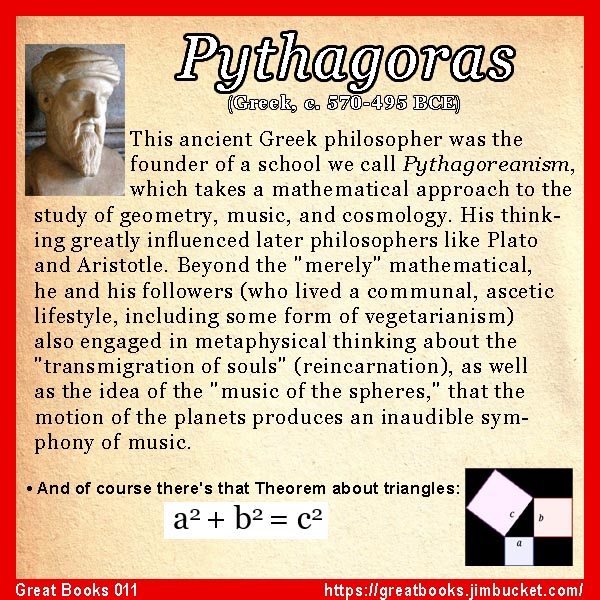
Pythagoras

PYTHAGORAS (Greek, c. 570-495 BCE)

This ancient Greek philosopher was the founder of a school we call Pythagoreanism, which takes a mathematical approach to the study of geometry, music, and cosmology. His thinking greatly influenced later philosophers like Plato and Aristotle. Beyond the "merely" mathematical, he and his followers (who lived a communal, ascetic lifestyle, including some form of vegetarianism) also engaged in metaphysical thinking about the "transmigration of souls" (reincarnation), as well as the idea of the "music of the spheres," that the motion of the planets produces an inaudible symphony of music.

  • And of course there's that Theorem about triangles...


Navigation: