Showing posts with label Jewish. Show all posts

Friday, April 22, 2022

The Christian Scriptures

THE CHRISTIAN SCRIPTURES (Greek/Jewish, perhaps  mid-to-late first century CE)

The so-called "New Testament" portion of The Holy Bible, focusing on the life and teachings of Jesus of Nazareth, called the Christ. It starts with four more or less biographical "Gospels," followed by a history of the early Church (Acts). Most of the rest is letters: 14 attributed to one Paul, each addressed to a local church or an individual; seven more called "Catholic epistles," meaning they're addressed to the Church in general; and finally the apocalyptic Book of Revelation, claiming to be a peek into the end of the world. The entire collection consists of 27 books (a list agreed on by virtually all Christian denominations), and follows the Hebrew Scriptures (or "Old Testament"), the structure of which varies between Judaism, Catholicism, and Protestantism.


Navigation:

Wednesday, April 6, 2022

Josephus

JOSEPHUS (Romano-Jewish historian, c. 37-100 CE)

Flavius Josephus was born in Jerusalem under Roman rule. He headed Jewish forces against the Romans in Galilee, surrendering in 67 CE after a six-week siege. Impressed by the young man, the Roman leader Vespasian kept him as a slave and, after becoming emperor, gave him his freedom. Granted Roman citizenship, he served on the Roman side at the siege of Jerusalem in 70 CE. Writing in Greek, he recorded the Jewish history of the first century CE in The Jewish War; his 20-volume Antiquities of the Jews starts with Biblical "history" from Adam and Eve and leads up to his day.

  • Some manuscripts of the Antiquities mention Jesus, his brother James, and John the Baptist. Scholars argue over how much, if any, of this was written by Josephus; if authentic, it would clearly have significance as an independent confirmation of some aspects of the Bible accounts.


Navigation:

Friday, April 1, 2022

Philo of Alexandria

PHILO OF ALEXANDRIA (Hellenistic Jew, c. 20 BCE-50 CE)

Philo of Alexandria (or Philo Judaeus) was a Hellenistic Jewish philosopher from Alexandria, Egypt. Using allegory, he harmonized Jewish scriptures with Greek philosophy at a time when the Jews were heavily influenced by Greek culture. His use of allegory seemed to deny that the events of the scriptures (and especially the first five books, the Pentateuch) were historical, yet Philo often advocated a literal, historical reading of those books. He wrote the Quaestiones ("Inquiries") on Genesis and Exodus; an Allegorical Commentary explaining the esoteric meanings of Genesis; and the Exposition of the Law, a more straightforward synthesis of topics in the Pentateuch, probably meant to be read by gentiles as well as Jews. He is also credited with writing a few other historical and philosophical works.


Navigation:

Saturday, March 19, 2022

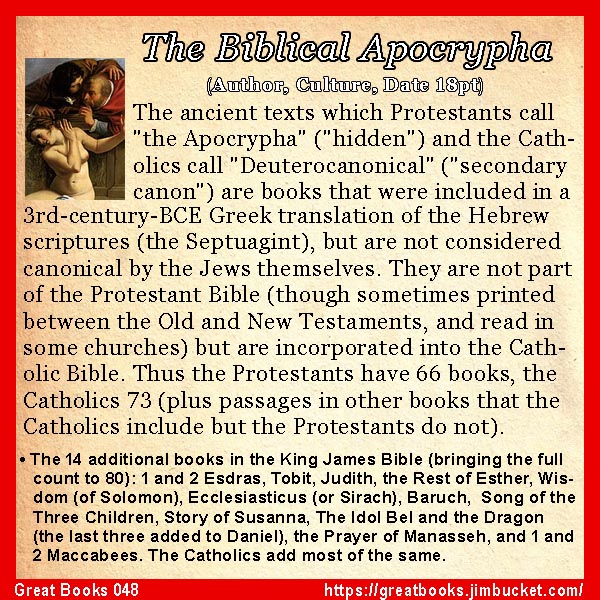
The Biblical Apocrypha

THE BIBLICAL APOCRYPHA (Jewish, c. 200 BCE-400 CE)

The ancient texts which Protestants call "the Apocrypha" ("hidden") and the Catholics call "Deuterocanonical" ("secondary canon") are books that were included in a 3rd-century-BCE Greek translation of the Hebrew scriptures (the Septuagint), but are not considered canonical by the Jews themselves. They are not part of the Protestant Bible (though sometimes printed between the Old and New Testaments, and read in some churches) but are incorporated into the Catholic Bible. Thus the Protestants have 66 books, the Catholics 73 (plus passages in other books that the Catholics include but the Protestants do not).

  • The 14 additional books in the King James Bible (bringing the full count to 80): 1 and 2 Esdras, Tobit, Judith, the Rest of Esther, Wisdom (of Solomon), Ecclesiasticus (or Sirach), Baruch, Song of the Three Children, Story of Susanna, The Idol Bel and the Dragon (the last three added to Daniel), the Prayer of Manasseh, and 1 and 2 Maccabees. The Catholics add most of the same.


Navigation:

Saturday, February 19, 2022

Pirkei Avot

PIRKEI AVOT (200 BCE-200 CE)

The "Chapters (or Ethics) of the Fathers" were compiled from Rabbinic Jewish tradition dating to a couple of centuries before and after the birth of Jesus.

  • A summary of some of the teachings in its five short chapters reads like a modern self-help book:
    • be kind
    • respect the rights of others 
    • strive for greatness
    • seek peace
    • avoid transgression
    • be humble
    • combine scripture learning with labor
    • be careful with speech
    • do not judge
    • the time for action is now
    • be patient


Navigation:

Friday, February 18, 2022

The Hebrew Scriptures

THE HEBREW SCRIPTURES (Jews, 8th/7th to 2nd/1st centuries BCE)

The Jewish people have a tradition of maintaining religious writings in the Hebrew language. The Masoretic Text (codified 7th to 10th century CE) consists of 24 books similar to those of the Protestant Christian so-called Old Testament, which divides the same material into 39 books and arranges it in a different order. (Catholic and Orthodox Bibles contain added materials).

The Hebrew scriptures are divided into three sections:

  • The Torah or "Five Books of Moses," identical to those in the Christian Scriptures;
  • The Nevi'im (Prophets), including historical and quasi-historical books--from Joshua to Kings, designated the "Former prophets"--as well as writings attributed to 3 prophets like Isaiah and "The Twelve" including Hosea to Malachi; and
  • The Ketuvim (Writings), more or less poetic books like Psalms, Proverbs, and Job, as well as short books like the Song of Songs, Ruth, and Esther.


Navigation: