Showing posts with label MiddleEastern. Show all posts

Saturday, March 19, 2022

The Biblical Apocrypha

THE BIBLICAL APOCRYPHA (Jewish, c. 200 BCE-400 CE)

The ancient texts which Protestants call "the Apocrypha" ("hidden") and the Catholics call "Deuterocanonical" ("secondary canon") are books that were included in a 3rd-century-BCE Greek translation of the Hebrew scriptures (the Septuagint), but are not considered canonical by the Jews themselves. They are not part of the Protestant Bible (though sometimes printed between the Old and New Testaments, and read in some churches) but are incorporated into the Catholic Bible. Thus the Protestants have 66 books, the Catholics 73 (plus passages in other books that the Catholics include but the Protestants do not).

  • The 14 additional books in the King James Bible (bringing the full count to 80): 1 and 2 Esdras, Tobit, Judith, the Rest of Esther, Wisdom (of Solomon), Ecclesiasticus (or Sirach), Baruch, Song of the Three Children, Story of Susanna, The Idol Bel and the Dragon (the last three added to Daniel), the Prayer of Manasseh, and 1 and 2 Maccabees. The Catholics add most of the same.


Navigation:

Friday, March 4, 2022

The Dead Sea Scrolls

THE DEAD SEA SCROLLS (Jewish, 3rd century BCE to 1st century CE)

Around the time of Jesus, and not far from the Dead Sea, a Jewish sect, probably the Essenes, established a community of men dedicated to voluntary poverty, daily "baptism," and asceticism. Fast-forward to 1946/47 when a Bedouin shepherd tossed a rock into a cave and hear something go "CLINK!" He had broken a jar, that turned out to contain two-thousand-year-old manuscripts that, once they came to the attention of scholars, changed our understanding of the Bible forever. About 40% are texts from the Hebrew Scriptures; 30% from extra-Biblical texts like Enoch, Jubilees, Tobit, etc.; 30% are sectarian texts (rules, rituals, etc.). Research into the content and significance of the scrolls continues.

  • 981 different manuscripts have been discovered in 11 caves.

Navigation:

Monday, January 31, 2022

The Epic of Gilgamesh

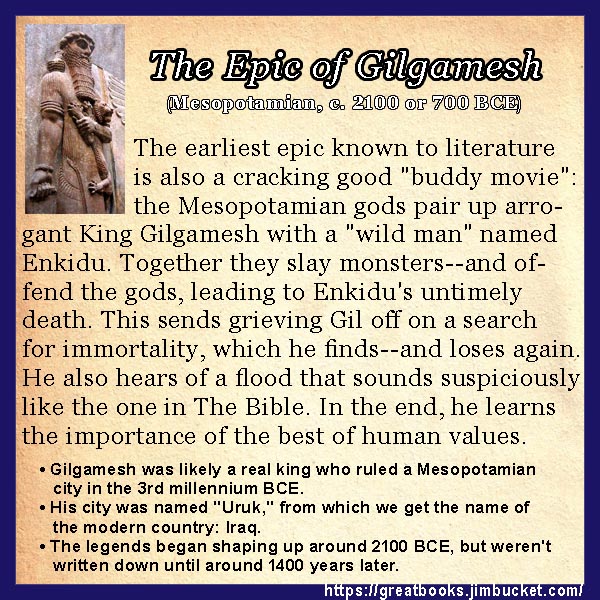
THE EPIC OF GILGAMESH (Mesopotamian, c. 2100 or 700 BCE)

The earliest epic known to literature is also a cracking good "buddy movie": Mesopotamian gods pair up arrogant King Gilgamesh with a "wild man" named Enkidu. Together they slay monsters--and offend the gods, leading to Enkidu's untimely death. This sends grieving Gil off on a search for immortality, which he finds--and loses again. In the end, he learns the importance of the best of human values.

  • Gilgamesh was likely a real king who ruled a Mesopotamian city in the 3rd millennium BCE.
  • His city was named "Uruk," from which we get the name of the modern country: Iraq.
  • The legends began shaping up around 2100 BCE, but weren't written down until around 1400 years later.


Navigation: