Showing posts with label Fables. Show all posts

Sunday, March 13, 2022

The Panchatantra

THE PANCHATANTRA (Vishnusharma?, Indian, about 200 BCE)

The Panchatantra ("Five Treatises") is a collection of fables that shares a style and a few stories with the Jataka Tales and Aesop. It's also the source of some stories in the Arabian Nights and other works. Like that later work, the stories are arranged in an embedded "Russian Doll" structure. The (probably fictitious) author, Vishnusharma, is named in the Introduction. Unlike Aesop, each of the five books has a frame story that provides a loose theme.

The Five Books:

  • Book 1, "The Loss of Friends": 30+ fables about Damanaka, a wily jackal serving a lion king; the longest book, making up 45% of the whole
  • Book 2, "The Winning of Friends": 10 fables about four friends: a crow, a mouse, a turtle, and a deer (22%)
  • Book 3, "On Crows and Owls": 18 fables, mainly about war and peace (26%)
  • Book 4, "Loss of Gains": 13 fables with morals (7%)
  • Book 5, "Ill-Considered Action": 12 fables with cautionary morals, mainly featuring human characters (?%, but short)


Navigation:

Saturday, March 5, 2022

The Jataka Tales

THE JATAKA TALES (Indian, 300 BCE-400 CE)

In Buddhism, the Jataka Tales are considered to be stories of the previous lives of the Buddha (Jataka means "birth"), with around 550 of them in one collection. Whenever the Buddha tells one, he identifies who he was (always a virtuous figure), and which characters in the story were which of his disciples. But the stories are, for the most part, more like Aesop, the 1,001 Nights, or the Indian Panchatantra. One of the most famous tells of a prince giving his body to feed a dying tiger, saving both her and her seven cubs. The prince, of course, is the Buddha-to-be. In another, he is captain of a ship who--as the lesser of two evils--kills a robber who plans to kill 500 merchants, even though this will be a setback to his attainment of enlightenment.


Navigation:

Wednesday, February 9, 2022

Aesop

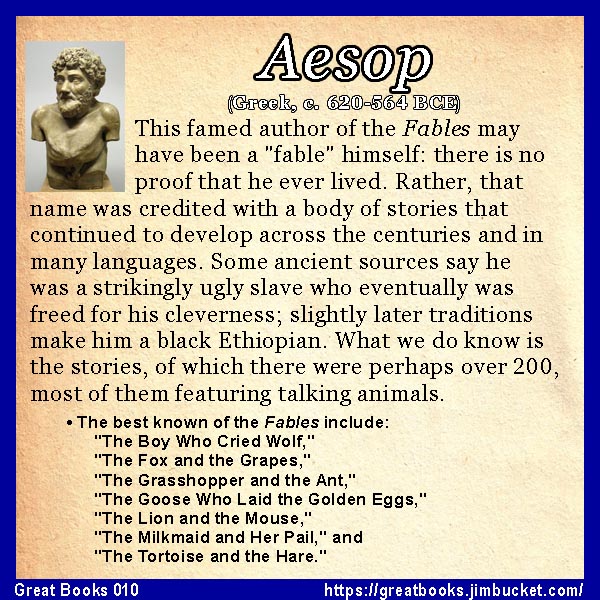
AESOP (Greek, c. 620-564 BCE)

This famed author of the Fables may have been a "fable" himself: there is no proof that he ever lived. Rather, that name was credited with a body of stories that continued to develop across the centuries and in many languages. Some ancient sources say he was a strikingly ugly slave who eventually was freed for his cleverness; slightly later traditions make him a black Ethiopian. What we do know is the stories, of which there were perhaps over 200, most of them featuring talking animals.

  • The best known of the Fables include:
    • "The Boy Who Cried Wolf,"
    • "The Fox and the Grapes,"
    • "The Grasshopper and the Ant,"
    • "The Goose Who Laid the Golden Eggs,"
    • "The Lion and the Mouse,"
    • "The Milkmaid and Her Pail," and
    • "The Tortoise and the Hare."


Navigation: